
What is the Shiva Tandava Stotram?
The Shiva Tandava Stotram is a Sanskrit hymn of praise to Lord Shiva, traditionally composed and sung by Ravana, the ten-headed king of Lanka. In fifteen verses it describes Shiva’s tandava, his fierce cosmic dance, image by image: the Ganga in his hair, the serpents at his throat, the drum, the fire, the crescent moon. It is one of the most chanted and most loved hymns in all of Hindu devotion.
That is the short answer. The long answer is one of the strangest and most beautiful stories in the scriptures: the story of how the proudest king on earth was crushed under a mountain, and sang his way out.
This guide is written for three readers, and you are one of them. If you chant the stotram already, here is the full text with a meaning you may never have had time to sit with. If you listen to it on your phone and love the sound, here is what the words are actually saying. And if you have just met the name and want to know why half a million people a month search for it, here is the whole story, from the Ramayana to the recording you can hear tonight.
How the hymn was born: Ravana under Kailash
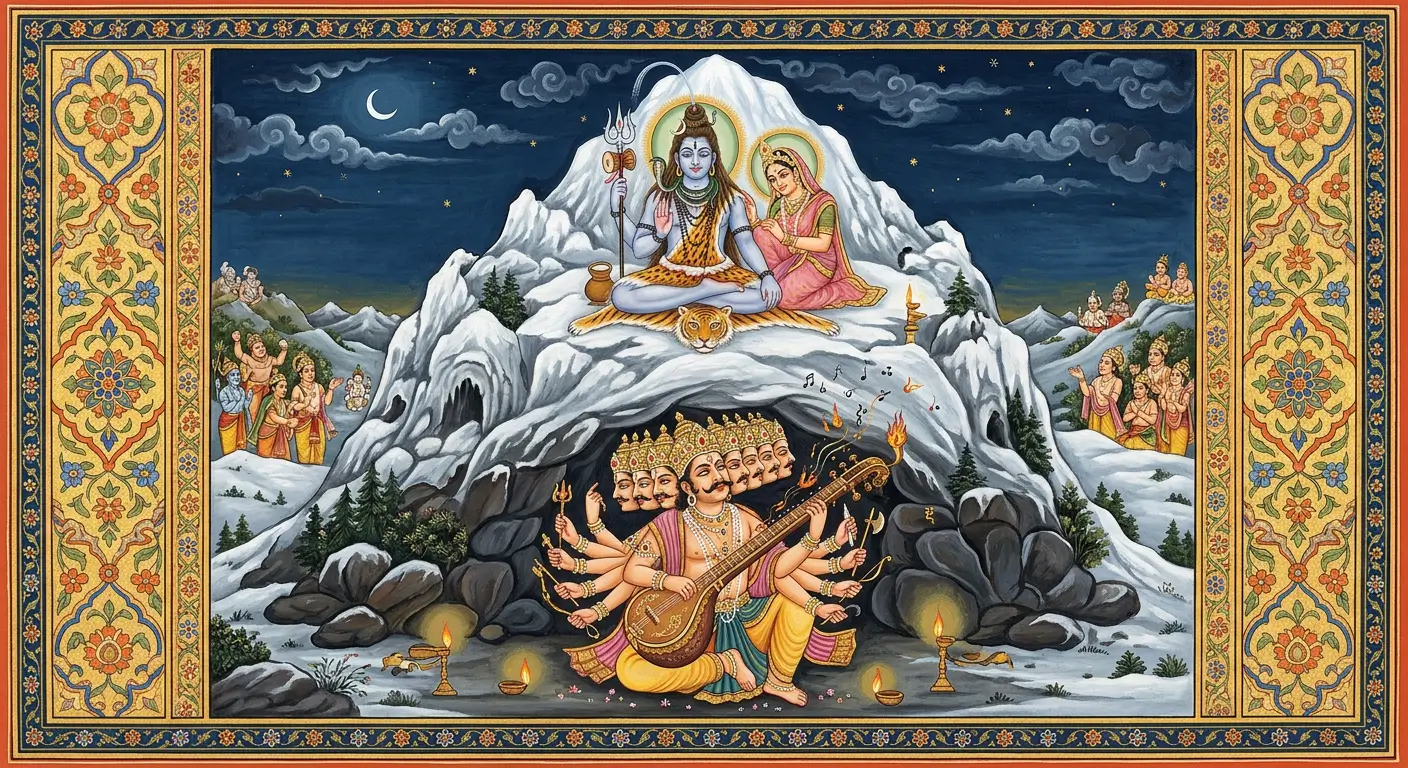
Long before Ravana became the enemy of Rama, he was something else. He was a scholar, a master of the Vedas, a player of the veena, and a devotee of Shiva of terrifying intensity. The tradition remembers him as one of the greatest Shiva bhaktas who ever lived. That is the paradox this hymn comes from, and we will sit with it properly before this guide ends.
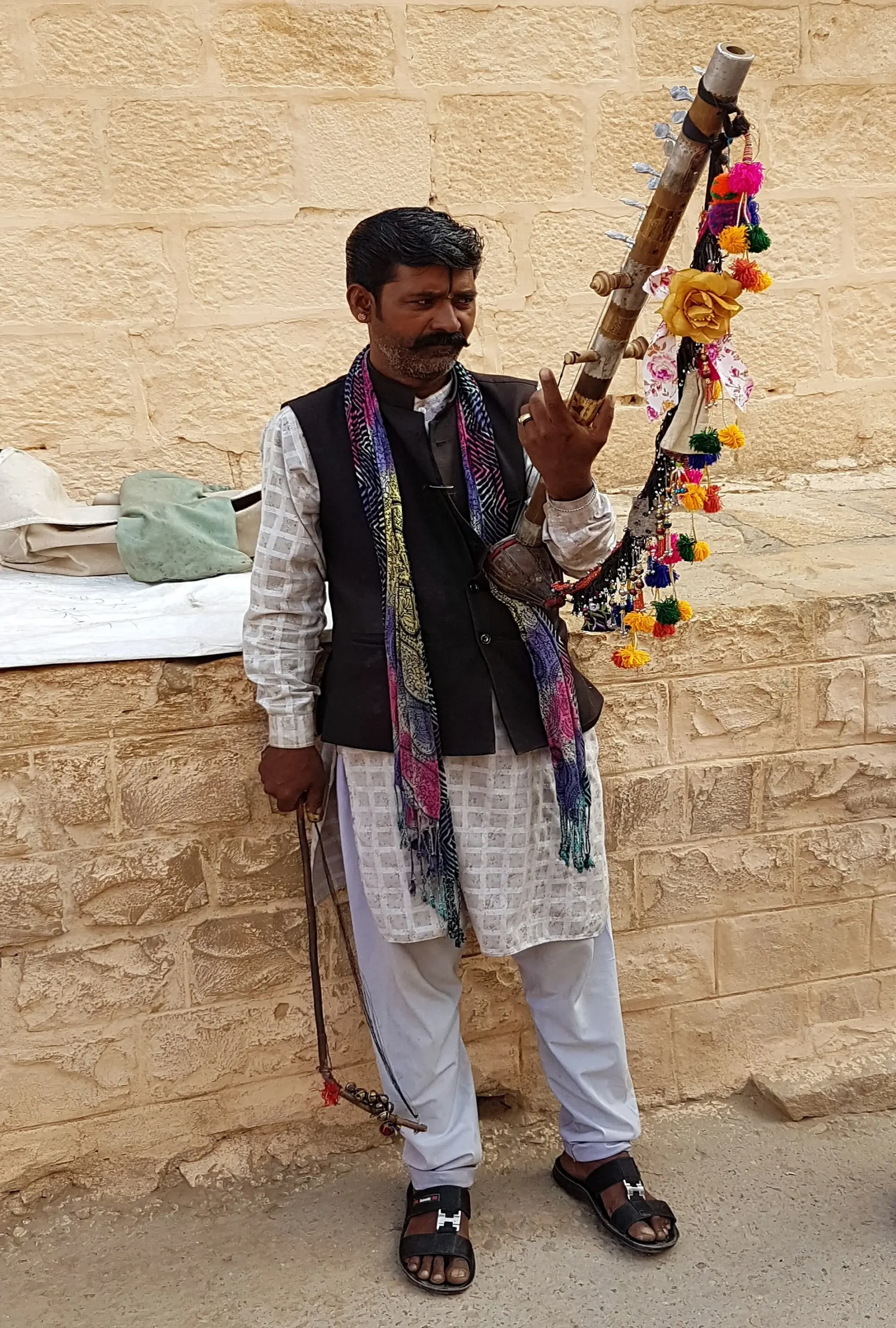
Consider who this man was, because the hymn makes more sense the more you know. Ravana was a rishi’s grandson, born Brahmin by blood and rakshasa by conduct. He had performed austerities so severe that he cut off his own heads, one after another, as offerings to Shiva, and the tradition says Shiva restored him each time. He had studied the Vedas until there was nothing left to study. He played the veena with such mastery that the tradition puts a veena in his hands in art and legend alike. Ten heads, twenty arms, the wealth of three worlds, the knowledge of all the scriptures, and a hunger that none of it could ever fill.
That is the man who tried to lift Kailash. And that is the man who, under the mountain, finally gave everything he had left: his voice.
The story is told in the Uttara Kanda, the final book of the Ramayana, in an episode the tradition calls Ravananugraha, the grace shown to Ravana.
Ravana had just defeated his own half-brother Kubera, the god of wealth and the keeper of the world’s treasures. Kubera’s city Alaka stands near Mount Kailash itself, in the country of the gods, and Ravana had looted it and taken its greatest prize: the Pushpaka Vimana, the flying chariot that moves at the speed of thought. He was flying home to Lanka in the Pushpaka Vimana, the flying chariot he had taken from Kubera, loaded with treasure.
Then, over the mountains, the chariot stopped. It could not fly on.
At the spot stood Nandi, Shiva’s bull and gatekeeper. Nandi told him why the road was closed: Shiva and Parvati were on Kailash, and no one passes over the mountain where the Lord sits.
Ravana laughed at Nandi. He mocked the bull and mocked the god who rode him. Nandi cursed him for it: one day, he said, monkeys will be your end. Anyone who knows the Ramayana knows how that curse played out, thousands of years later, through Hanuman and the vanara army.
Ravana, furious, did the most Ravana thing possible. He decided to lift the mountain.
He put all twenty of his arms under Kailash and pushed. The mountain shook. Inside, Parvati grabbed Shiva in fear. And Shiva, calm as always, simply pressed the mountain back down with the big toe of one foot.
Twenty arms. The pride of the king of Lanka. Under one toe.
Ravana was trapped. Crushed under the mountain he tried to carry, he roared with pain, and the roar was so enormous that, the tradition says, it became his name: Ravana, the one who cried out.
His ministers told him the truth. You cannot fight this one. You can only worship him. So the king who could not be humbled did the only thing left: he sang.
He sang to Shiva for a thousand years, they say, trapped under the mountain. And the verses of that song were gathered and kept, and they are the fifteen verses the world now chants as the Shiva Tandava Stotram. When Shiva finally lifted his toe, he gave Ravana his freedom and a gift: the sword Chandrahasa, the moon-smile, a weapon of terrible power. The greatest hymn to Shiva in Sanskrit literature was, in the traditional account, composed by a crushed and desperate king, under the mountain, in the dark.
The tradition does not end the story with the hymn. It follows the gift. Chandrahasa made Ravana near-invincible, and near-invincible made him worse. Every later grief of the Ramayana, the abduction of Sita, the war, the fall of Lanka, grew from the pride the sword fed. Some tellings add the strangest grace note of all: that in the final battle, it was Shiva’s own presence in Ravana’s devotion that made Rama honour him even while ending him. Devotion, the tradition keeps insisting, and conduct, are two different things, and heaven weighs them separately.
The other telling: the climb up the southern face
Sadhguru tells the story differently, and his telling is loved by millions. In his version, Ravana walked all the way from the south to Kailash, and as he approached, he began to sing the praises of Shiva, beating time on a drum. He composed, extempore, a thousand and eight verses. Shiva listened, lost in the music, and as Ravana sang, he climbed. Hand over hand, verse over verse, he came up the southern face of the mountain, until Parvati saw this man nearly at the top and had to shake Shiva out of his rapture.
Both tellings agree on what matters: a king, a mountain, a song so true that Shiva himself was held by it. And they agree that what survives in the received text is only the heart of a much longer composition.
The Tamil telling: the veena of his own head
One more version deserves telling, because it is the most haunting of all. In the Tamil tradition, trapped under Kailash, Ravana did something no one else in any story has done. He cut off one of his own ten heads and made a veena of it. He strung it with his own tendons. And on that instrument, made of himself, he sang until Shiva relented.
Devotion, the tradition says, does not count the cost. That is the whole message of this hymn, in one image.
What does tandava mean?
Tandava is the name of Shiva’s dance. The word carries the sense of something vigorous, fierce, wild with power. This is not a gentle sway. The tandava is the dance in which the universe is made and unmade: Shiva’s drum beats, and creation begins; his fire flares, and what is finished dissolves; his foot comes down, and time itself moves.
In the Hindu understanding, the dance is not a picture of the universe. It is the universe. Every atom that exists, every birth and every ending, is a movement inside this one dance. The calmest form of the same truth is Nataraja, Shiva as the lord of the dance, the great Chola bronze where all of it stands still in one graceful pose. If you want to go deeper into Shiva himself, his names, symbols and forms, our complete guide to Lord Shiva opens all of it.
And where does the dance happen, in the tradition? At Chidambaram, the great temple of Tamil Nadu, Shiva is honoured as Nataraja performing the ananda tandava, the dance of bliss, before the sages Patanjali and Vyaghrapada. The tradition also tells of a dance contest there between Shiva and the goddess Kali, which belongs to her story more than this one. The dance has many homes. But the hymn you are reading about was born on Kailash, and that mountain has its own place in this guide.
The hymn that sounds like the dance
Before you read the verses, one thing will multiply your joy in them. This hymn is built so that the sound of the Sanskrit performs the dance it describes.
Every line runs sixteen syllables, short and long alternating, a rolling, galloping rhythm that never lets go. Scholars of metre describe the pattern one way; your ears will describe it better. Read the first verse aloud and you will hear it.
Now listen to three sound-words inside it.
Ḍamaḍ, ḍamaḍ, ḍamaḍ, ḍamaḍ. That is the damaru, Shiva’s small two-headed drum, beating in the first verse.
Dhagad, dhagad, dhagad. That is fire crackling on a forehead, in the second verse and again in the seventh. It is the sound of the third eye.
Dhimid, dhimid, dhimid. That is the mridanga, the great drum, rolling under the eleventh verse as the tandava reaches its peak.
The poet did not write about the dance. He wrote the dance. The drum is in the words. The fire is in the words. When millions of people listen to this hymn on their phones and in their temples without knowing a word of Sanskrit, this is what their bodies are hearing: rhythm inside rhythm, the universe drumming.
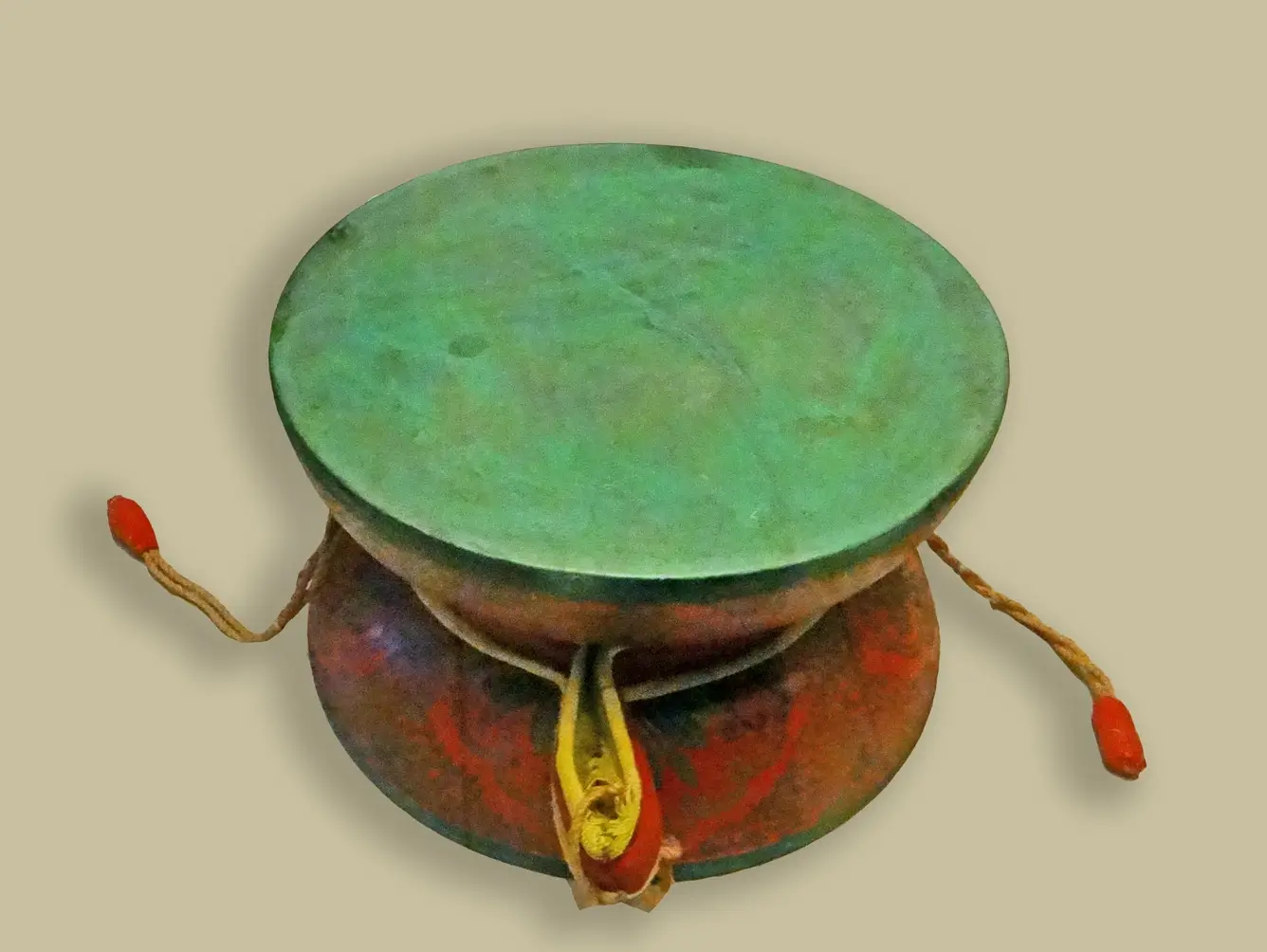
Here is how to hear it yourself, even without a word of Sanskrit. Play any recording and listen three times. First time, follow the drum. Second time, wait for the long rolling lines, the ones the singer speeds through like water over stones; those are the description verses. Third time, listen for the moment the cascade begins, the ender of this, the ender of that, verse 9 and verse 10, where every phrase lands on the same beat like a hammer on a nail. You now hear the hymn’s architecture, and it never leaves you again.
Remember who the tradition says the poet was. A master of language, a veena player, a man with ten heads, crushed under a mountain, composing in the one language he had left. That is the craft you are about to read.
The full Shiva Tandava Stotram: Devanagari, IAST and English meaning
Here is the complete hymn, all fifteen verses of the received text, exactly as it is chanted today. Each verse appears three times: first in Devanagari, the script it was composed in, then in IAST, the standard Roman transliteration that shows every sound, and then in English, in our own plain rendering. The Sanskrit text is the traditional received text, public domain, cross-checked against the Wikisource original.
One honest note before you begin. Recensions vary. Most printed texts carry fifteen verses, the fourteen of the hymn proper plus the final phala verse, the verse of fruits. Some carry sixteen or seventeen, and editions differ in a few small word choices here and there; where they differ, this text follows the reading the great recordings follow. What follows is the fifteen-verse text that the great recordings follow and that most temples use.
The hymn at a glance
| Verse | Its moment of the dance |
| 1 | The opening picture: Ganga in the hair, serpents at the throat, the drum, the dance begins |
| 2 | The whirl: hair spinning, the river churning, fire on the forehead, the crescent moon |
| 3 | Parvati beside him; the horizon trembles; his glance stops calamity |
| 4 | The serpents’ jewels smearing the sky like saffron; the wonder of the watcher |
| 5 | The gods in an endless line; flower dust on his feet; the moon as his crown |
| 6 | The third eye that swallowed Kama’s arrows; the wealth of his matted hair |
| 7 | The same feet that destroy also draw creation’s patterns: the one Artist |
| 8 | Monsoon clouds held still; the new-moon darkness worn as a necklace |
| 9 | The dark poison like a blue lotus on his throat; the destroyer cascade begins |
| 10 | The cascade completed: the ender of the ender, the death of death itself |
| 11 | The full dance: serpents hissing, the altar-fire, the mridanga rolling, victory to Shiva |
| 12 | The turn: when will my mind see jewel and clay, friend and enemy, the same |
| 13 | The king’s real prayer: a cave, a river, folded hands, when will I be happy |
| 14 | The hymn’s own promise: purification and devotion for whoever holds it |
| 15 | The song of the ten-faced one: prosperity for the one who sings at Pradosha |
Read it as a whole and you can see the architecture. Verses 1 to 8 are the dance seen from outside, image after image. Verses 9 to 11 are the dance at full power. And verses 12 to 15 are the quiet after: what the singer himself actually wants. The hymn moves from spectacle to prayer, which is the whole journey of devotion in fifteen verses.
Verse 1, opened word by word
The first verse is the whole hymn in miniature, so we open it slowly, word by word, as a model for reading the rest.
Verse 1
जटाटवीगलज्जलप्रवाहपावितस्थले ।
गलेऽवलम्ब्य लम्बितां भुजङ्गतुङ्गमालिकाम् ।
डमड्डमड्डमड्डमन्निनादवड्डमर्वयं ।
चकार चण्डताण्डवं तनोतु नः शिवः शिवम् ॥ १ ॥
jaṭāṭavīgalajjalapravāhapāvitasthale
gale’valambya lambitāṃ bhujaṅgatuṅgamālikām ।
ḍamaḍḍamaḍḍamaḍḍamanninādavaḍḍamarvayaṃ
cakāra caṇḍatāṇḍavaṃ tanotu naḥ śivaḥ śivam ॥ 1 ॥
The words, one by one. Jaṭā: matted hair. Āṭavī: a forest. His hair is a forest. Galajjala: the water that pours from it, the Ganga. Pravāha: the flowing stream. Pāvita: purifying. Sthale: on the ground. So the first line says: from his forest of matted hair the sacred river pours down and makes the ground holy. Gale: on his neck. Avalambya: resting against. Lambitām: hanging down. Bhujaṅga: serpents. Tuṅga: lofty, raised high. Mālikām: a garland.
The second line: on his neck hang the great serpents, worn like a garland. Ḍamaḍ ḍamaḍ ḍamaḍ ḍamaḍ: the sound of his damaru drum. Nināda: the echoing roar of it. Arvayam: filling the air everywhere. Cakāra: he performed. Caṇḍa: fierce, passionate. Tāṇḍavam: the tandava, the great dance. Tanotu: may he extend. Naḥ: to us. Śivaḥ śivam: Shiva, and auspiciousness itself.
Put together:
From his matted hair, dense as a forest, the sacred Ganga pours down and purifies the ground, and on that holy ground Shiva dances his fierce tandava. Around his neck the great serpents hang like a garland. His damaru drum fills the air everywhere with its beat, ḍamaḍ, ḍamaḍ, ḍamaḍ, ḍamaḍ. May that Shiva extend his auspicious dance into our beings also.
That is how every verse works: picture built on picture, sound inside sound. The rest follow, each with its plain English meaning.
Verses 2 to 5: the image of the dancer
Verse 2
जटाकटाहसम्भ्रमभ्रमन्निलिम्पनिर्झरी ।
विलोलवीचिवल्लरीविराजमानमूर्धनि ।
धगद्धगद्धगज्ज्वलल्ललाटपट्टपावके ।
किशोरचन्द्रशेखरे रतिः प्रतिक्षणं मम ॥ २ ॥
jaṭākaṭāhasambhramabhramannilimpanirjharī
vilolavīcivallarī virājamānamūrdhani ।
dhagaddhagaddhagajjvalallalāṭapaṭṭapāvake
kiśoracandraśekhare ratiḥ pratikṣaṇaṃ mama ॥ 2 ॥
His matted hair whirls like a great cauldron spinning, and within it the river goddess Ganga churns. The strands of his hair move like waves, like climbing vines. On his forehead a blazing fire crackles, dhagad, dhagad, dhagad: the third eye. Above it all shines the young crescent moon. Every moment I watch this dance, delight rises in me.
Verse 3
धराधरेन्द्रनन्दिनीविलासबन्धुबन्धुर ।
स्फुरद्दिगन्तसन्ततिप्रमोदमानमानसे ।
कृपाकटाक्षधोरणीनिरुद्धदुर्धरापदि ।
क्वचिद्दिगम्बरे मनो विनोदमेतु वस्तुनि ॥ ३ ॥
dharādharendranandinīvilāsabandhubandhura
sphuraddigantasantatipramodamānamānase ।
kṛpākaṭākṣadhoraṇī niruddhadurdharāpadi
kvaciddigambare mano vinodametu vastuni ॥ 3 ॥
Now the goddess is beside him: Parvati, daughter of the mountain king, his companion in every divine play. The whole horizon trembles with the force of the dance, and waves of it enter the mind and become joy. This is Shiva, whose single side-glance of grace can stop even the unstoppable calamity. Sky-clad, free of all wanting, he plays, and the play becomes the tandava. May my mind find its delight in him.
Verse 4
जटाभुजङ्गपिङ्गलस्फुरत्फणामणिप्रभा ।
कदम्बकुङ्कुमद्रवप्रलिप्तदिग्वधूमुखे ।
मदान्धसिन्धुरस्फुरत्त्वगुत्तरीयमेदुरे ।
मनो विनोदमद्भुतं बिभर्तु भूतभर्तरि ॥ ४ ॥
jaṭābhujaṅgapiṅgalasphuratphaṇāmaṇiprabhā
kadambakuṅkumadravapraliptadigvadhūmukhe ।
madāndhasindhurasphurattvaguttarīyamedure
mano vinodamadbhutaṃ bibhartu bhūtabhartari ॥ 4 ॥
The reddish serpents in his hair rear up and tremble, and the jewels in their hoods flash. Their red light spreads across the sky like liquid saffron, until the heavens themselves look like the face of a new bride. His garment ripples like the thick hide of a mighty elephant. Watching him, the sustainer of all beings, my mind is carried away in wonder.
Verse 5
सहस्रलोचनप्रभृत्यशेषलेखशेखर ।
प्रसूनधूलिधोरणी विधूसराङ्घ्रिपीठभूः ।
भुजङ्गराजमालया निबद्धजाटजूटकः ।
श्रियै चिराय जायतां चकोरबन्धुशेखरः ॥ ५ ॥
sahasralocanaprabhṛtyaśeṣalekhaśekhara
prasūnadhūlidhoraṇī vidhūsarāṅghripīṭhabhūḥ ।
bhujaṅgarājamālayā nibaddhajāṭajūṭakaḥ
śriyai cirāya jāyatāṃ cakorabandhuśekharaḥ ॥ 5 ॥
The gods themselves stand in an endless line to honour him: Sahasra-lochana, the thousand-eyed Indra, and all the rest. Flowers fall from their crowns, and the dust of those flowers settles on his feet and dyes them. His matted hair is bound with the king of serpents as its garland. Above it shines the moon, the friend of the chakora birds, who are said to drink moonlight. May that moon on his head grant us lasting auspiciousness and grace.
Verses 6 to 8: the fire, the artist, the night
Verse 6
ललाटचत्वरज्वलद्धनञ्जयस्फुलिङ्गभा ।
निपीतपञ्चसायकं नमन्निलिम्पनायकम् ।
सुधामयूखलेखया विराजमानशेखरं ।
महाकपालिसम्पदेशिरोजटालमस्तु नः ॥ ६ ॥
lalāṭacatvarajvaladdhanañjayasphuliṅgabhā
nipītapañcasāyakaṃ namannilimpanāyakam ।
sudhāmayūkhalekhayā virājamānaśekharaṃ
mahākapālisampade śirojaṭālamastu naḥ ॥ 6 ॥
On the field of his forehead a spark of fire leaps and spreads its light. That fire once swallowed the five flower-arrows of Kamadeva, the god of love, and made him bow. On Shiva’s head shines the crescent moon, drawn like a line of nectar. May we also receive a share of the treasure that lives in the matted hair of the great Kapalin, the skull-bearing Lord.
Verse 7
करालभालपट्टिकाधगद्धगद्धगज्ज्वलद् ।
धनञ्जयाहुतीकृतप्रचण्डपञ्चसायके ।
धराधरेन्द्रनन्दिनीकुचाग्रचित्रपत्रक ।
प्रकल्पनैकशिल्पिनि त्रिलोचने रतिर्मम ॥ ७ ॥
karālabhālapaṭṭikādhagaddhagaddhagajjvalad
dhanañjayāhutīkṛtapracaṇḍapañcasāyake ।
dharādharendranandinīkuchāgracitrapatraka
prakalpanaikaśilpini trilocane ratirmama ॥ 7 ॥
The terrible band of his forehead blazes, dhagad, dhagad, dhagad, the fire that made an offering of the five arrows of Kama. And the same feet that dance destruction are, on the breast of the earth, the feet of the one Artist who draws all patterns of creation. My heart rests in that three-eyed Lord.
Verse 8
नवीनमेघमण्डली निरुद्धदुर्धरस्फुरत् ।
कुहूनिशीथिनीतमः प्रबन्धबद्धकन्धरः ।
निलिम्पनिर्झरीधरस्तनोतु कृत्तिसिन्धुरः ।
कलानिधानबन्धुरः श्रियं जगद्धुरन्धुरः ॥ ८ ॥
navīnameghamaṇḍalī niruddhadurdharasphurat
kuhūniśīthinītamaḥ prabandhabaddhakandharaḥ ।
nilimpanirjharīdharastanotu kṛttisindhuraḥ
kalānidhānabandhuraḥ śriyaṃ jagaddhurandharaḥ ॥ 8 ॥
The dance has held even the churning monsoon clouds still. Around his neck he has bound the darkness of the new-moon night itself. Bearer of the Ganga, wearer of the elephant hide, treasury of every art, bearer of the universe’s weight: may he extend his auspiciousness to us all.
Verses 9 and 10: the destroyer cascade
Verse 9
प्रफुल्लनीलपङ्कजप्रपञ्चकालिमप्रभा ।
वलम्बिकण्ठकन्दलीरुचिप्रबद्धकन्धरम् ।
स्मरच्छिदं पुरच्छिदं भवच्छिदं मखच्छिदं ।
गजच्छिदान्धकच्छिदं तमन्तकच्छिदं भजे ॥ ९ ॥
praphullanīlapaṅkajaprapañcakālimaprabhā
valambikaṇṭhakandalīruciprabaddhakandharam ।
smaracchidaṃ puracchidaṃ bhavacchidaṃ makhacchidaṃ
gajacchidāndhakacchidaṃ tamantakacchidaṃ bhaje ॥ 9 ॥
The dark stain of the halahala poison rests on his throat like a blooming blue lotus, worn as an ornament by his own will. And now the hymn names him, one act at a time. I worship the one who cut down Kama, the god of desire. The one who cut down the three demon cities, Tripura. The one who cuts the bond of worldly existence. The one who cut down Daksha’s sacrifice. The one who slew the elephant demon. The one who slew Andhaka. And the one who holds back even Yama, death itself.
Verse 10
अकर्वसर्वमङ्गलाकलाकदम्बमञ्जरी ।
रसप्रवाहमाधुरीविजृम्भणामधुव्रतम् ।
स्मरान्तकं पुरान्तकं भवान्तकं मखान्तकं ।
गजान्तकान्धकान्तकं तमन्तकान्तकं भजे ॥ १० ॥
akharvasarvamaṅgalākalākadambamañjarī
rasapravāhamādhurī vijṛmbhaṇāmadhuvratam ।
smarāntakaṃ purāntakaṃ bhavāntakaṃ makhāntakaṃ
gajāntakāndhakāntakaṃ tamantakāntakaṃ bhaje ॥ 10 ॥
He is the never-failing source of every auspicious thing, and all the arts bloom from him like a cluster of kadamba flowers, sweet as a stream of honey. And the cascade comes again, deeper: I worship the ender of Kama, the ender of the demon cities, the ender of worldly bondage, the ender of the sacrifice, the ender of the elephant demon, the ender of Andhaka. And last, the phrase the whole hymn has been climbing toward: tam antakāntakam. The ender of the ender. The death of death itself.
Verse 11: the dance at full power
Verse 11
जयत्वदभ्रविभ्रमभ्रमद्भुजङ्गमश्वसद् ।
विनिर्गमत्क्रमस्फुरत्करालभालहव्यवाट् ।
धिमिद्धिमिद्धिमिध्वनन्मृदङ्गतुङ्गमङ्गल ।
ध्वनिक्रमप्रवर्तितप्रचण्डताण्डवः शिवः ॥ ११ ॥
jayatvadabhravibhramabhramadbhujaṅgamaśvasad
vinirgamatkramasphuratkarālabhālahavyavāṭ ।
dhimiddhimiddhimidhvananmṛdaṅgatuṅgamaṅgala
dhvanikramapravartita pracaṇḍatāṇḍavaḥ śivaḥ ॥ 11 ॥
Victory to Shiva. The serpents at his throat hiss and their hot breath feeds the fire on his forehead like offerings on an altar. And beneath it all the great mridanga rolls, dhimid, dhimid, dhimid, beat after beat, and to that drumming, fierce and endless, Shiva dances the tandava. This is the verse that the famous recordings ride on, and once you can hear the drum in the words, you never lose it again.
Verses 12 and 13: the king’s real prayer
Verse 12
दृषद्विचित्रतल्पयोर्भुजङ्गमौक्तिकस्रजोः ।
गरिष्ठरत्नलोष्टयोः सुहृद्विपक्षपक्षयोः ।
तृणारविन्दचक्षुषोः प्रजामहीमहेन्द्रयोः ।
समं प्रवर्तयन्मनः कदा सदाशिवं भजे ॥ १२ ॥
dṛṣadvicitratalpayorbhujaṅgamauktikasrajoḥ
gariṣṭharatnaloṣṭayoḥ suhṛdvipakṣapakṣayoḥ ।
tṛṇāravindacakṣuṣoḥ prajāmahīmahendrayoḥ
samaṃ pravartayanmanaḥ kadā sadāśivaṃ bhaje ॥ 12 ॥
Listen to what the king asks for. Not kingdoms. Not weapons. He asks: when will my mind see the same in a hard bed and a soft one? In a serpent and a garland of pearls? In a priceless jewel and a lump of clay? In a friend and an enemy? In the common eye and the lotus eye? In a beggar and an emperor? When, with that evenness, will I worship Sadashiva, the ever-auspicious? It is the same equanimity the Bhagavad Gita teaches, asked for in the voice of a man who owned the flying chariot and could not use it.
Sit with the pairs one more time, slowly, because each one is a small teaching on its own. The jewel and the clay: things. The serpent and the pearl garland: fear and beauty. The friend and the enemy: the social world. The common eye and the lotus eye: how we rank what we see. The beggar and the emperor: power. Every way a mind divides the world into more and less, the verse names it, and asks when the measuring will end.
Verse 13
कदा निलिम्पनिर्झरीनिकुञ्जकोटरे वसन् ।
विमुक्तदुर्मतिः सदा शिरःस्थमञ्जलिं वहन् ।
विमुक्तलोललोचनो ललामभाललग्नकः ।
शिवेति मन्त्रमुच्चरन्कदा सुखी भवाम्यहम् ॥ १३ ॥
kadā nilimpanirjharīnikuñjakoṭare vasan
vimuktadurmatiḥ sadā śiraḥsthamañjaliṃ vahan ।
vimuktalolalocano lalāmabhālalagnakaḥ
śiveti mantramuccaran kadā sukhī bhavāmyaham ॥ 13 ॥
And then the plainest words in the whole hymn. When will I live in a little cave beside the celestial river? When will my wrong thoughts be gone, my hands folded on my head, my eyes steady, my forehead marked with sacred ash, simply saying the name of Shiva? When will I be happy? The ten-headed emperor of the world, who had just tried to carry a mountain, asking for a cave, a river and a mantra. Every human being who has ever been tired of their own life hears this verse and knows it was written for them.
Verses 14 and 15: what the hymn itself promises
Verse 14
इमं हि नित्यमेवमुक्तमुत्तमोत्तमं स्तवं ।
पठन्स्मरन्ब्रुवन्नरो विशुद्धिमेतिसन्ततम् ।
हरे गुरौ सुभक्तिमाशु याति नान्यथा गतिं ।
विमोहनं हि देहिनां सुशङ्करस्य चिन्तनम् ॥ १४ ॥
imaṃ hi nityamevamuktamuttamottamaṃ stavaṃ
paṭhansmaranbruvannaro viśuddhimetisantatam ।
hare gurau subhaktimāśu yāti nānyathā gatiṃ
vimohanaṃ hi dehināṃ suśaṅkarasya cintanam ॥ 14 ॥
Whoever reads this hymn, remembers it, and speaks it, says the tradition’s own closing word, becomes purified, and devotion to the great Guru, Hara, arises quickly in them. There is no other way needed. For the mere thought of Shankara, it says, unwinds the delusion of the living. This is the hymn’s promise about itself, and we hold it as exactly that: the tradition’s own claim, in its own voice.
Verse 15
पूजावसानसमये दशवक्त्रगीतं यः ।
शम्भुपूजनपरं पठति प्रदोषे ।
तस्य स्थिरां रथगजेन्द्रतुरङ्गयुक्तां ।
लक्ष्मीं सदैव सुमुखीं प्रददाति शम्भुः ॥ १५ ॥
pūjāvasānasamaye daśavaktragītaṃ yaḥ
śambhupūjanaparaṃ paṭhati pradoṣe ।
tasya sthirāṃ rathagajendraturaṅgayuktāṃ
lakṣmīṃ sadaiva sumukhīṃ pradadāti śambhuḥ ॥ 15 ॥
The final verse, the song of the ten-faced one, Ravana himself. Whoever sings this hymn in the evening, at Pradosha, at the close of puja, to that person Shambhu grants steady Lakshmi: prosperity like chariots and elephants and horses, and a graceful face of fortune that never turns away. Again, this is the hymn naming its own fruit, in the tradition’s own register of images, and devotees have taken it at its word for centuries.
इति श्रीरावणकृतं शिवताण्डवस्तोत्रं सम्पूर्णम् ।
Thus ends the Shiva Tandava Stotram, composed by Ravana.
Three verses to sit with
Fifteen verses can be chanted in seven minutes. Three of them can be lived with for a lifetime.
The destroyer cascade, verses 9 and 10. Twice the hymn counts Shiva’s acts of ending, and twice it ends the count beyond death itself: the ender of the ender. Read it as a list and it sounds like violence. Read it as the tradition reads it and it is a ladder. Kama is desire. Tripura is the three cities of ego, in one reading the three states of waking, dream and sleep. Daksha’s sacrifice is arrogance wearing the clothes of religion. Andhaka is the blindness that cannot see what matters. What is being ended, one rung at a time, is everything in a human being that believes it is separate. The dance does not destroy you. It destroys the cage.
The equanimity prayer, verse 12. The jewel and the clay. The friend and the enemy. The beggar and the emperor. Ravana, who had more than any man alive and wanted more, asking for the one thing he lacked: a mind that no longer measures. Every meditation tradition on earth, in every language, is trying to teach what this one verse asks for in four lines.
The when-will-I-be-happy verse, verse 13. This is the verse to keep. A cave. A river. Folded hands. Ash on the forehead. A name on the lips. When will I be happy? The emperor of the world reduced, by one toe on one mountain, to the smallest and truest prayer a human being can make. If you only ever learn one verse of this hymn by heart, tradition would not blame you for choosing this one.
What the hymn promises, in its own words
Let us be careful and honest here, because this is where most pages about the stotram lose their way.
The hymn itself makes two promises, in its own final verses. First, purification and quickened devotion for whoever reads, remembers and recites it. Second, steady prosperity for whoever sings it at Pradosha after puja. Those are the tradition’s own claims, in the tradition’s own voice, and we quote them exactly that way.
Devotees add their own testimony. On the discussion forums where practitioners talk, the same words come back again and again: daily recitation brings peace of mind. It brings stillness before sleep. It changes the feeling of a room. Teachers in several lineages hold certain times as especially supportive: any time at all is valid, with eclipse hours, dawn, dusk, and the Pradosha window on the thirteenth lunar day held special.
There is a quiet difference between how the tradition speaks about fruits and how the modern internet speaks about benefits, and it is worth naming. The tradition offers its gifts inside a relationship: you come closer to Shiva, and closeness changes what you want and how steadily you can hold your life. The internet often sells the hymn as a vending machine. Our house stands with the tradition. Chant it because the chanting itself steadies you, and let whatever else comes, come. The hymn’s own words are better than that. It promises purification, devotion, a mind that measures less, and in the end, the end of the fear of ending. Devotees over a thousand years have considered that the better deal.
Can we read Shiv Tandav Stotram daily? How to chant it
Yes. This is one of the most asked questions about the hymn, and the answer is simple. There is no restriction in the tradition on reading it daily, and daily recitation is exactly what its most devoted practitioners do. There is no bar on women chanting it. There is no bar on listening to it. The hymn belongs to anyone who will receive it, which, if you have read the story of its author, is the entire point.
If you are beginning, here is a path that works.
Step one: listen. Find a recording you love and live with it. The version most listeners know is by Uma Mohan, on the album Divine Chants of Shiva, released by Times Music on 24 January 2007. Let it play in the morning, in the car, while you cook. Your ear learns the rhythm before your mind learns anything. Do not skip this step. The hymn is music before it is text.
Step two: understand. Come back to the verse block above and read one verse a day with its meaning. Use the word-by-word opening of verse 1 as your model. You are not learning a foreign language; you are learning thirty pictures. A forest of hair. A river in the sky of it. A drum. A fire. A moon.
Step three: chant along. Follow the recording with the Devanagari or the IAST in front of you, one verse at a time, at whatever speed you need. The sound matters more than the speed. When a verse settles into your body, it is yours.
Step four: make it yours. Many people chant the full fifteen verses each morning. Many chant only verses 1, 9, 10 and 13. Many simply play it at Pradosha time and fold their hands. The tradition’s guidance, repeated across teachers, is that regularity matters more than length. Ten honest minutes daily beats an hour once a month.
The five sounds that matter
Sanskrit has a few sounds English does not, and the stotram uses all of them. You do not need to master them to chant. You need only to know they exist, and your mouth will learn them from the recording long before your mind does.
The dots under letters matter. Ṭ and ḍ, with a dot under, are pronounced with the tongue curled back, further back than English t and d, closer to how some American English speakers say the t in true or water. There are more of these in this hymn than in almost any other text you will chant, because the drum sounds themselves, ḍamaḍ, ḍamaḍ, are made on that heavy, back-of-the-mouth beat.
Ś and ṣ are both sh sounds, made slightly differently, and both are simply sh to a beginner’s ear. That is fine. The ṃ you see at the end of words like tāṇḍavaṃ is an anusvāra, a nasal hum; let the vowel before it close gently into an m or an n sound, whatever the flow of the line suggests, and you will be within the tradition.
The ḥ you see in śivaḥ is a gentle breath out, like the h at the end of an exhale. Say Shiva and let a little breath follow it: shi-vah. That is all.
And the long vowels, ā ī ū, simply take twice the time. That is not a detail. It is the meter. The long and short vowels are the wave the whole hymn rides on, so when you hold the long vowels honestly, the rhythm of the dance appears on its own.
Why the recording and the text look different
Sooner or later every learner hits this, and it stops them for a day, so let us meet it now. When you follow a recording with the text, the words will not always line up. The singer seems to run three written words into one. Whole syllables appear that you cannot find on the page.
This is not an error, in the text or in your ears. It is sandhi, the Sanskrit system where words that stand side by side fuse at their join. Jaṭā plus āṭavī becomes jaṭāṭavī. The final vowel of one word melts into the opening vowel of the next. Sanskrit is built to be spoken in exactly this way; the writing keeps the words joined, the singing keeps the sound flowing, and the learner stands between them holding both.
The practical path: do not chase the text word by word while listening. Learn verse by verse. Read the verse once in Devanagari or IAST, read its meaning once, then listen to that verse and let the sound and the sense settle together. The joins that confuse the eye become obvious to the ear within a few hearings.
A forty-day beginning
If you want a frame, the tradition’s oldest one is forty days, a mandala, the classic cycle for settling a practice. Ten days listening. Ten days with verse 1 and the word-by-word opening above. Ten days adding your favourite three verses. Ten days with the full hymn, at whatever pace you can hold. At the end of forty days you will not have performed it. You will have it, the way you have a friend’s voice, and it will be yours for life.
For the days you cannot chant
Illness, travel, a house of guests, a throat that will not cooperate: the practice does not stop, it only changes form. The tradition counts mental recitation, and listening, and even holding the hymn in mind without a single sound as real practice. On the hardest days, play the recording and fold your hands. That counts. The hymn was composed by a man whose arms were pinned under a mountain. It has always known that the voice is not the only way to sing.
And the second question people ask: is it good to play it, without chanting? Yes. Listening, shravanam, is one of the nine classic forms of bhakti in the tradition. Playing the stotram in your home is a practice. Many households play it in the morning, or on Mondays, or through the night of Maha Shivaratri. Some people find the fierce rhythm too energising just before sleep and prefer it in the morning. That is a matter of your own body, not of rule.
The stotram through the year
The hymn has no season, but the year gives it rhythm, and knowing the rhythm connects you to millions of households.
Through Shravan, the monsoon month of Shiva, the stotram plays almost everywhere in the Hindu world. This is the month of the kanwariyas walking with Ganga water on their shoulders, and the sound of the tandava from every speaker on the road.
On Pradosha, the thirteenth lunar evening twice a month, temples sing it at the close of puja, which is exactly what verse 15 asks for.
On Mondays it belongs with the morning prayer, the simplest weekly rhythm of Shiva devotion.
And on Maha Shivaratri, the great night of Shiva, it runs through the four watches of the night. The 2027 night falls on Saturday 6 March, and if you are ever in a temple or a home where it is being sung at two in the morning, you will hear why the tradition keeps this hymn for its fiercest and most awake hours.
The hymn in stone and song
The Shiva Tandava Stotram has a twin tradition in sculpture, and almost nobody who chants it knows this part of the story.
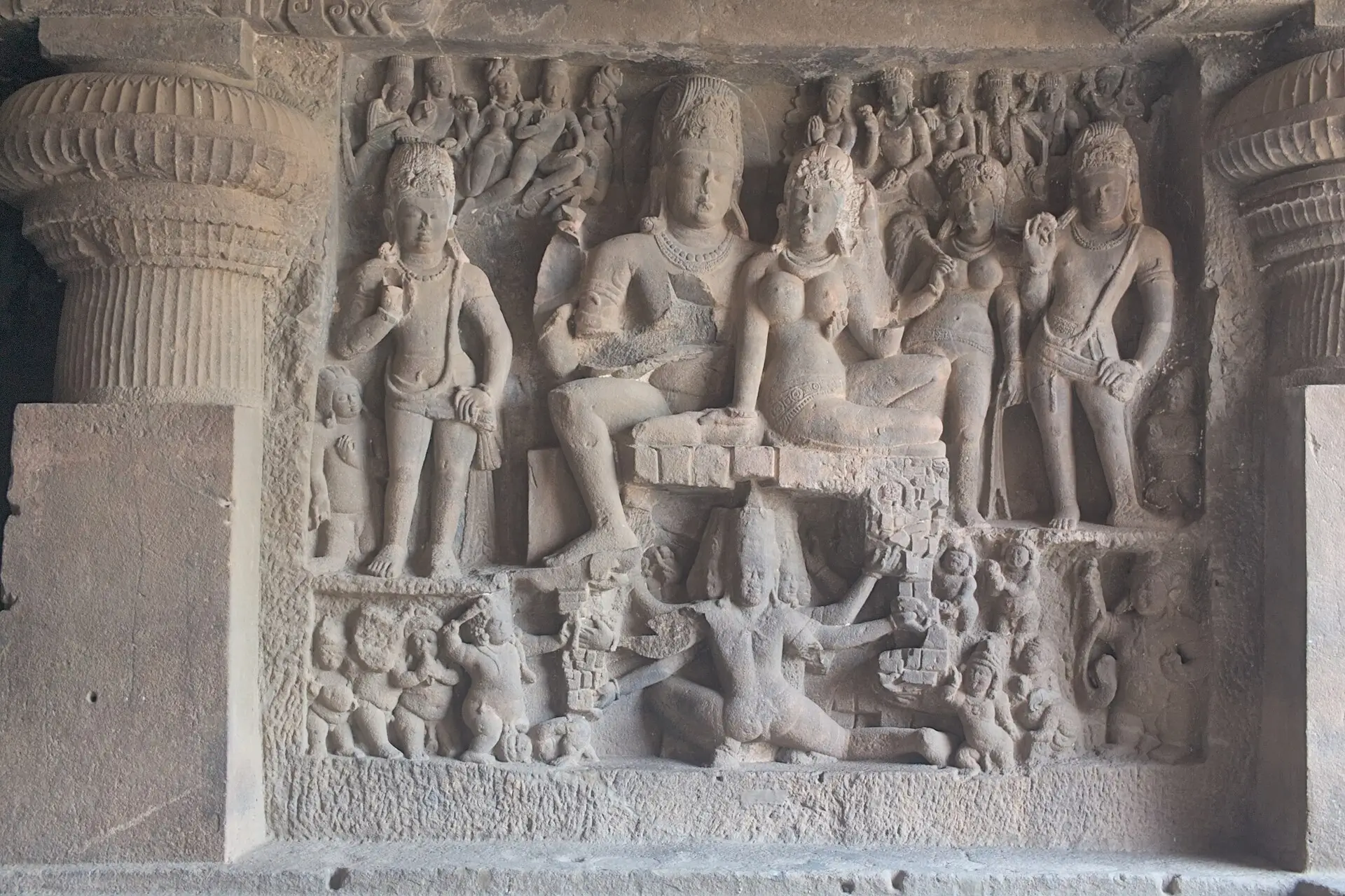
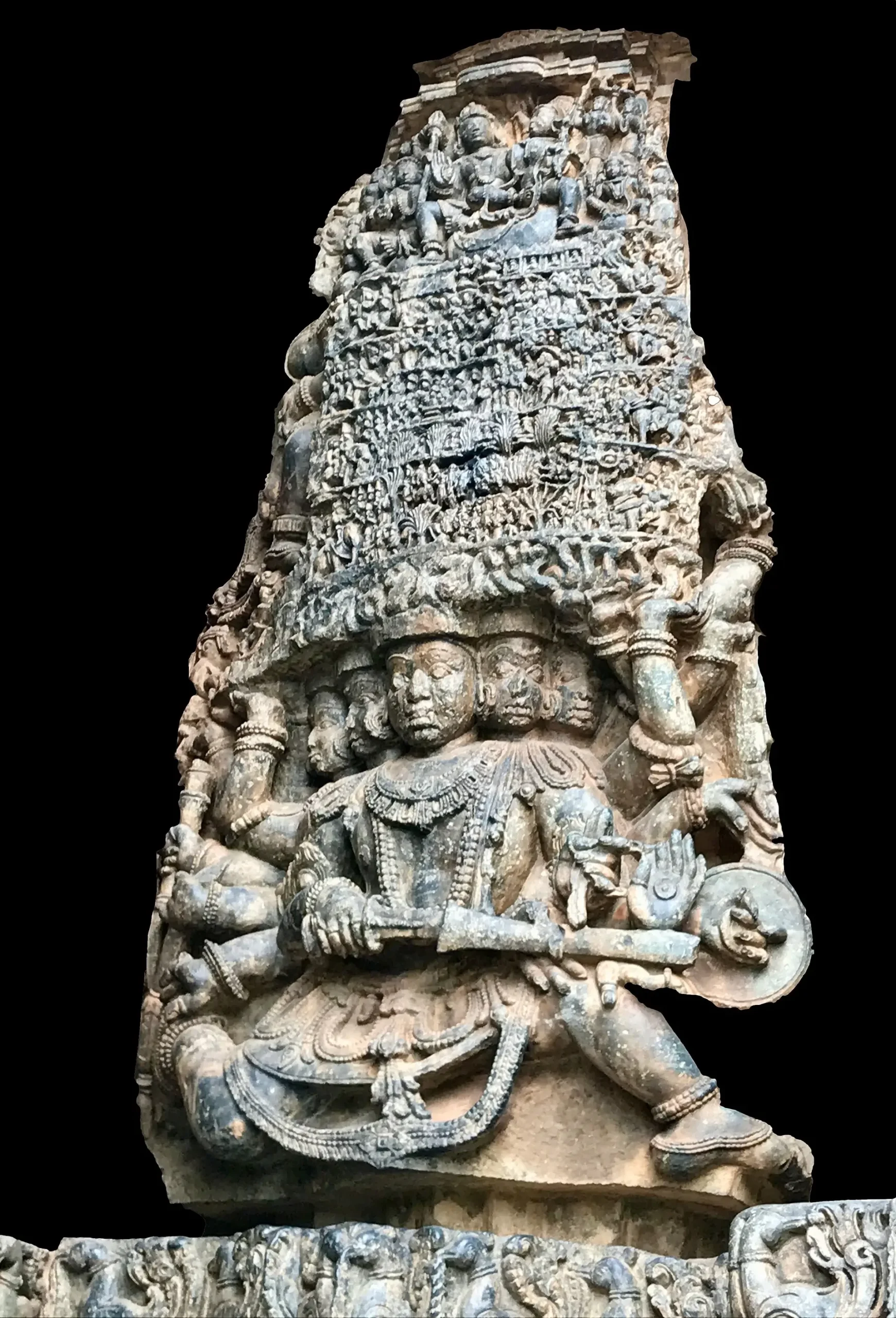
The scene of Ravana under the mountain, singing, while Shiva and Parvati sit calm above, is a recognised form in temple art. It is called Ravananugraha, the grace shown to Ravana. The most celebrated carving of it is in the Kailasa temple at Ellora, the astonishing monolithic temple cut downward out of a single basalt cliff by the Rashtrakuta king Krishna I between about 756 and 783 CE. Carvers removed hundreds of thousands of tonnes of rock to leave this one temple standing free, and on its walls they told the story of the mountain it imitates. In the Ravananugraha panel, Shiva sits calm at the summit with Parvati beside him, the mountain’s inhabitants crowded on its slopes, and beneath the whole mass, arms braced, the straining figure of the singer. Britannica calls that panel a composition of considerable grace and charm. The Hoysala artists carved it at the Hoysaleshwar temple at Halebeedu, with Ravana’s eyes bulging and his legs straining under the whole weight of Kailash. Chola bronze artists cast the same scene in metal. Somewhere in India, in almost every century, a sculptor was telling this same story in stone while the singers were telling it in sound.
Then came the screen and the speaker. The stotra entered Indian film music in 1958, in the Telugu film Bhookailas, and it never really left. It sounds through the Baahubali films, where Kailash Kher’s recording of it became famous to a new generation, and the singer spoke of getting goosebumps in the studio singing it. It runs through Shivaay, Satyameva Jayate, Manikarnika, Pattas and more. And in 2007, Uma Mohan’s serene, rolling rendition on Divine Chants of Shiva became, for the streaming era, the version: millions upon millions of plays across platforms, the sound of Shravan evenings and Shivaratri nights in Hindu homes from New Jersey to New Zealand.
A hymn born under a mountain, carved into temple walls, sung on film, streamed on phones. Fifteen verses have travelled a long way from the dark under Kailash.
Ravana the poet
One more thing belongs in the record, because it is usually left out. Whoever composed these verses was a poet of the first rank, and Sanskrit literary tradition has always known it. The hymn works as sound, as picture and as prayer at once, which is the hardest thing a devotional poem can do. Its structure, spectacle turning to confession, is the structure of great lyric poetry in any language. The tradition’s verdict is preserved in the way it treats the author: whatever else it says about Ravana, it never once says he was anything less than a master of words. The hymn you have just read is the evidence, and it has carried his name for over two thousand years for exactly that reason.
The Ravana paradox
Here is the question every thoughtful reader eventually asks. Ravana is the villain of the Ramayana. How is the villain the author of one of Hinduism’s most sacred hymns?
The tradition never found this a contradiction. It found it the point.
Ravana was the greatest scholar of his age, the author of works on medicine and music, a bhakta of such intensity that he tried to carry Shiva’s mountain home as a gift for his mother. And he was also greed, pride and appetite walking on ten legs, who brought down everything he loved. The tradition holds both truths about him at once, and the Shiva Tandava Stotram is the hinge where they meet: the moment the proudest being in the world runs out of everything except song.
What does Shiva do with that? He listens for a thousand years, and he grants the boon. That is the teaching devotees take from this hymn, and it is the same teaching the tradition gives about Shiva himself, the Bholenath, the easily pleased. He does not check your credentials. He does not weigh your past. A crushed and honest heart, under a mountain or anywhere else, is received. In Sri Lanka, the memory of Ravana the devotee is alive to this day. The island’s Hindu tradition holds that Ravana worshipped Shiva at its great temple sites, and some of the oldest temples of the Tamil east coast, like Koneswaram on its ocean cliff, carry his name in their local stories. Devotees there remember him not as a footnote to the Ramayana but as a Shiva bhakta, a scholar king and a maker of hymns, which is exactly what the Shiva Tandava Stotram preserves.
Our complete guide to Lord Shiva follows this teaching through his names, his forms and his stories, if you want the whole map.
The mountain where it happened
One last thing, and it is the reason this house tells this story at all.
The mountain in the hymn is a real mountain. Kailash stands in the high Tibetan plateau, 6,638 metres of black rock and snow, the peak no one has ever climbed. The tradition holds that Shiva and Parvati sit there still, and that the pilgrim who walks the circle of the mountain, the kora, walks around the same ground where a twenty-armed king once sang for a thousand years. Our guides to why Kailash is sacred to four faiths and to the mountain’s sacred geography tell that whole story, from the four faces to the great rivers that begin at its feet.
There is a detail in the story that pilgrims treasure. In the other telling, the one Sadhguru gives, Ravana climbed the southern face while he sang. The southern face of Kailash is the face every trekker sees first, the sheer black wall that rises above the valley of Darchen. The hymn is not set in some distant heaven. It is set on a mountain you can walk to, on a face you can stand before, and pilgrims on the kora carry their practice with them; this hymn, made for walking and drums, is one that travels easily.
We have been walking pilgrims to that mountain since 2006. If the hymn has done to you what it has done to some readers, if somewhere in verse 13 you felt a cave and a river and a name calling, then you already understand why the journey exists. When that wish becomes a plan, our journeys are there, and the mountain is exactly as the hymn describes: quiet, enormous, and aware.
What is the most powerful Shiva stotram?
People ask this, and the honest answer is that the tradition crowns no single hymn. Ask the devotees of the Rudrashtakam and they will give you their answer. Ask those who love the Shiva Mahimna Stotra, or the Panchakshara Stotram, or the Sri Rudram from the Vedas, and each will speak with complete conviction. The Shiva Tandava Stotram is the most dramatic, the most musical, and the most chanted of them all. Whether it is the most powerful is a question your own practice will answer better than any list. The stotras of Shiva deserve their own guide, and it is coming in this same series.
Frequently asked questions
What is the Shiva Tandava Stotram?
A Sanskrit hymn of fifteen verses praising Shiva’s cosmic dance, the tandava. Tradition attributes it to Ravana, the king of Lanka, who is said to have composed and sung it while trapped under Mount Kailash. It describes Shiva dancing, image by image, from the Ganga in his hair to the drum, the fire, the crescent moon and the serpents at his throat.
Can we read Shiv Tandav Stotram daily?
Yes. The tradition places no restriction on daily recitation, and daily recitation is the standard practice of its most devoted chanters. Regularity matters more than length. Many people chant it every Monday morning, at Pradosha, or through the night of Maha Shivaratri.
What is the most powerful Shiva stotram?
The tradition crowns no single hymn. The great ones are the Shiva Tandava Stotram, the Shiva Mahimna Stotra, the Rudrashtakam, the Panchakshara Stotram and the Sri Rudram. Devotees of each will tell you theirs is supreme, with total sincerity. The Tandava Stotram is the most widely chanted and the most dramatic. The rest is between you and your practice.
Is it good to play Shiv Tandav Stotram?
Yes. Listening is shravanam, one of the nine classic forms of devotion. Playing the stotram at home, in the car or during meditation is a valid practice followed in countless households. Some prefer it in the morning because the rhythm is energising. There is no rule; there is only what your own practice loves.
Why did Ravana compose it?
According to the Uttara Kanda of the Ramayana, Ravana tried to lift Mount Kailash after being barred from flying over it. Shiva pressed the mountain down with his toe and trapped him. Advised that only praise could free him, Ravana sang this hymn for a thousand years, and Shiva released him and gave him the sword Chandrahasa.
Is the Shiva Tandava Stotram in the Ramayana?
The story of Ravana and the mountain is told in the Uttara Kanda, the final book of the Ramayana. The hymn’s authorship by Ravana is the traditional attribution. Scholars note that the text as we chant it today has come through later recensions, which is why we hold the attribution as tradition, warmly and honestly.
How many verses does it have?
Fifteen in most received texts: fourteen verses of the hymn plus the final phala verse, the verse of fruits. Some recensions carry sixteen or seventeen. The famous recordings follow the fifteen-verse text.
What does tandava mean?
Shiva’s vigorous, fierce dance, the dance in which the universe is created and dissolved. The word carries intensity and power. Its calm, blissful counterpart shown in the Nataraja bronze is the ananda tandava, the dance of bliss.
What do damad damad and dhagad dhagad mean?
They are onomatopoeia, sound-words. Damad, damad is the beating of Shiva’s damaru drum. Dhagad, dhagad is the crackle of the fire on his forehead, the third eye. In verse 11, dhimid, dhimid is the roll of the mridanga drum. The hymn is built so that the sounds of the dance live inside the words themselves.
When is the best time to chant it?
Any time. Teachers across lineages agree there is no fixed hour, and several hold special times as especially supportive: dawn, dusk, the Pradosha window on the thirteenth lunar day, eclipse hours, Monday, and the night of Maha Shivaratri.
Can women chant the Shiva Tandava Stotram?
Yes, completely. Shiva is the most gender-inclusive of the Hindu deities; the Ardhanarishvara form shows the goddess as literally half of his own body. Women chant this hymn, teach it and record it. Any restriction you may hear belongs to some individual custom somewhere, not to Shiva and not to the hymn.
What is Chandrahasa?
The celestial sword Shiva granted Ravana when he released him from under Kailash. The name means moon-smile. The tradition says Ravana’s power and his later downfall both grew from that gift, which is its own long story in the Ramayana.
Why was Ravana a devotee of Shiva?
The tradition remembers Ravana as a towering scholar and an intense bhakta of Shiva who performed austerities of unbelievable severity, at the same time as he was pride and appetite in a crown. The paradox is the point of his character: devotion and destruction lived in the same man, and the hymn was born at the moment destruction failed and only devotion was left.
What is Ravananugraha?
The grace shown to Ravana. It is the name of both the episode in the Uttara Kanda and the recognised sculptural form: Shiva and Parvati seated on Kailash, Ravana beneath the mountain, singing. The great carving is at the Kailasa temple, Ellora, and the Hoysala version is at Halebeedu.
Which rendition of the stotram is most famous?
The version most listeners know is by Uma Mohan, from the album Divine Chants of Shiva, Times Music, 2007, six minutes and thirty-eight seconds. Kailash Kher’s recording for the film Baahubali brought it to another generation. Both are easy to find on every streaming platform.
Related guides
- Why Is Mount Kailash Sacred? The Four Faiths, One Mountain
- Mount Kailash Sacred Geography: The Land and Its Meaning
- Our journeys to Mount Kailash and Lake Mansarovar