
What are the mantras of Shiva?
The mantras of Shiva are the sacred sounds of the Shaiva tradition: the Panchakshara Om Namah Shivaya at their heart, the Mahamrityunjaya for healing, the Shiva Gayatri for illumination, the Rudra salutation, the beej seeds, and the great hymns of praise. Each has its own text, its own meaning and its own natural hour. This guide gathers them in one place, organized the way the tradition itself arranges them, so you can find the one your life is asking for.
That is the shelf. Below is the librarian: every mantra with its text in Devanagari and Roman transliteration, its meaning in plain English, and an honest map of which sound serves which hour of a human life.
Mantra, stotram, aarati: how the tradition arranges its sounds
Before the list, one distinction that will save you confusion everywhere else you read about Shiva.
A mantra is a seed. It is short, often a single line, built to be repeated. Its power is in the repetition, the way a seed’s power is in the planting. Om Namah Shivaya is a mantra. The Mahamrityunjaya is a mantra.
A stotram is a hymn. It has verses, a poet, a development, a story. It is praised rather than repeated: you sing through it, or listen to it, rather than cycling one line hundreds of times. The Tandava Stotram is a stotram. The Panchakshara Stotram is a stotram.
An aarati is the offering of light, the sung close of worship, the flame circled before the Lord at the end of puja. Its mantras are the temple’s evening voice.
| Form | What it is | Its example |
| Mantra | A seed, repeated | Om Namah Shivaya |
| Stotram | A hymn of praise, sung through | The Tandava Stotram |
| Aarati | The light song at worship’s close | Karpur Gauram |
The rest of this page follows the same order: the mantras first, then the hymns, then the light.
The eight mantras of Shiva, the heart of the page
These eight are the heart of the tradition. The first five are the core the tradition itself centers; the last three serve hours the first five do not reach. Each appears below with its text, its meaning and the hour it serves. The two with their own complete guides on this site are linked; the others are coming.
Om Namah Shivaya, the Panchakshara
नमः शिवाय
namaḥ śivāya
Salutations to Shiva, the auspicious one. Five syllables, Na Ma Shi Va Ya, one for each element of creation: earth, water, fire, air and space. Its seed lies in the Sri Rudram of the Yajurveda, and its full story, the syllable meanings, the Panchakshara Stotram in three scripts and the complete practice path, are in our complete guide to Om Namah Shivaya.
Its hour: every day, any hour. The tradition’s own starting point. If you keep only one mantra, the tradition’s answer is this one.
For the beginner, a practical entry: sit facing east if you can, hold a rudraksha mala if you have one, and chant oṃ na-ma-shi-vā-ya slowly, letting the long ā in vā and ya take twice the time of the short syllables. The soft sh of shi is as in ship. Ten unhurried minutes daily for forty days is the traditional first mandala, and the practice will tell you what it wants to become.
The Mahamrityunjaya mantra
ॐ त्र्यम्बकं यजामहे सुगन्धिं पुष्टिवर्धनम् ।
उर्वारुकमिव बन्धनान्मृत्योर्मुक्षीय मामृतात् ॥
oṃ tryambakaṃ yajāmahe
sugandhiṃ puṣṭivardhanam ।
urvārukamiva bandhanān
mṛtyor mukṣīya māmṛtāt ॥
We worship the three-eyed one, fragrant, nourishing all. As the ripe cucumber is released from its vine, so may we be released from death, not by tearing but by ripeness. From the Rigveda, 7.59.12, among the oldest verses still chanted by anyone on earth.
Its hour: illness, danger, the fear of endings. The hospital waiting room. The night a loved one is far from well. The cucumber comparison matters: the prayer is not against death but for ripeness, a completed life released gently rather than torn. Tradition connects it to the boy Markandeya, who overcame death by holding to Shiva; his full story and the mantra’s complete treatment have their own page coming.
Word by word: the Mahamrityunjaya
The mantra that serves the hardest hours deserves its words opened, one by one.
| Word | Traditional meaning |
| Om | The primordial sound, the seed of all mantras |
| Tryambakam | The three-eyed one. The two eyes see the world of form. The third sees what does not change. |
| Yajamahe | We worship, we adore, we offer ourselves |
| Sugandhim | The fragrant one, whose presence is sweet and all-pervading |
| Pushtivardhanam | He who increases nourishment and well-being in all beings |
| Urvarukam | The cucumber, growing ripe on its vine |
| Iva | Like, as. The word that makes the whole mantra a simile |
| Bandhanan | From its bond, its stalk, its attachment |
| Mrityor | From death, from the fear of endings, from what perishes |
| Mukshiya | May we be freed, released, let go |
| Ma | Not. The word that turns the prayer from denial to release |
| Amritat | Into immortality, the deathless, what does not perish |
Read as one sentence: we worship the three-eyed one, fragrant, nourishing all. As the ripe cucumber is released from its stalk, so may we be released from death. The cucumber is not torn from the vine. It ripens until the bond lets go by itself. That is the prayer’s entire teaching about how a life should end. That is the prayer’s entire teaching about how a life should end.
The Shiva Gayatri mantra
ॐ तत्पुरुषाय विद्महे महादेवाय धीमहि ।
तन्नो रुद्रः प्रचोदयात् ॥
oṃ tatpuruṣāya vidmahe
mahādevāya dhīmahi ।
tanno rudraḥ pracodayāt ॥
We know the Supreme Being. We meditate on the great God. May Rudra illuminate us. The Gayatri form is the tradition’s oldest meter of illumination, and this is its Shaiva face: a prayer not for things but for light on the mind itself.
Its hour: study, decision, the morning before anything that needs a clear head. The student’s and the seeker’s mantra. Its full page, with word-by-word meaning, is coming in this series.
Word by word: the Shiva Gayatri
| Word | Traditional meaning |
| Om | The primordial sound |
| Tat | That, the Supreme, the truth beyond naming |
| Purushaya | To the Purusha, the cosmic being, the person who is all persons |
| Vidmahe | We know, we seek to know, we hold in intellect |
| Mahadevaya | To the great God, the God of gods |
| Dhimahi | We meditate, we hold in contemplation |
| Tannah | May that one, may he |
| Rudrah | Rudra, the howler, the fierce one, the storm that clears |
| Pracodayat | Illuminate, inspire, impel toward the light |
The Gayatri meter is the oldest meter of illumination in the tradition, the meter of the Rigveda’s most famous verse. This is its Shaiva face: a prayer not for things but for light on the mind that decides.
Om Namo Bhagavate Rudraya
ॐ नमो भगवते रुद्राय
oṃ namo bhagavate rudrāya
Salutations to the Lord Rudra. The simplest salutation to the fierce form of Shiva, the howler, the storm. It honors the aspect the frightened mind most needs to greet: the power that clears what is finished, whether the world is ready or not.
Its hour: before undertaking what must be undertaken, and in the ripening of hard decisions. The great mother-hymn behind it, the Sri Rudram from the Yajurveda, is the source of the Panchakshara itself, and its complete story has its own page coming.
The name Rudra comes from the root rud, to cry, to howl, and the Vedas hear him in the storm. The salutation honors him by name, directly, without softening: not the gentle form first but the fierce one, because the tradition’s teaching is that the fierce form is gentle to those who approach with respect. Chant it when you need the courage of the storm rather than the peace of the summit.
The Shiva beej mantras
The beej mantras are single-syllable seeds, sounds the tradition regards as concentrated forms of divine energy. They are the strongest-smelling spices on the shelf, and the tradition treats them the same way a kitchen treats those spices: with respect, in small quantities, and in some traditions only after initiation. A beginner does not need them. The Panchakshara carries the whole tradition in five open syllables, and the beej page, when it comes, will explain what the seeds are and the care the tradition asks around them.
Its hour: after guidance, not before. This is the honest answer, and it is the one the tradition itself gives.
Eight mantras, eight hours, one Lord. The beginner who wants a single starting point takes the Panchakshara and keeps it. The rest of this page helps you find the others when life asks for them.
Om Hara Hara Mahadev
॥ हर हर महादेव
oṃ hara hara mahādeva
Hara, the one who takes away. Mahadev, the great God. The repeated hara hara is the sound of temples at festival, of crowds walking to Shravan water, of the collective voice that does not need to know Sanskrit to mean every syllable. Its power is in its simplicity and its volume: this is the mantra that strangers chant together, and the shared voice is part of its meaning.
Its hour: with others. On the road to the temple, at the aarati, in the Shravan walk. The private mantras above are for the quiet room. This one is for the road.
Om Namo Neelkanthaya
॥ नमो नीलकण्ठाय
oṃ namo nīlakaṇṭāya
Salutations to the blue-throated one. Neelakantha, the one whose throat turned blue from holding the halahala poison so that no one else would have to. This single line compresses the entire churning of the ocean story into a salutation: when the gods and demons churned the cosmic ocean for nectar, the first thing to rise was poison, and Shiva drank it.
Its hour: when you are holding something that is not yours to carry and cannot be put down. The poison you swallow so others do not have to. The blue throat is the mark of that quiet act.
The Ekadasa Rudra names
The eleven names of Rudra, from the Shatarudriya section of the Yajurveda, each with its own seed mantra. They are listed on several pages online, and we list them honestly here with the caution the tradition itself gives: the Ekadasa mantras belong to structured practice, traditionally under guidance, and a beginner does not need them. The names are Kapali, Pingala, Bhima, Virupaksha, Vilohita, Shastha, Ajapada, Ahirbhudhanya, Sambhu, Chanda and Bhava. If a teacher gives you one, chant it as given. Until then, the Panchakshara carries the whole tradition without reservation.
The stotram shelf: the hymns of praise
Where the mantras are seeds, these are the garlands: developed hymns, most with a poet and a story. Each deserves its own full page; two already have one.
| Stotram | Its voice, in one line | Where to find it |
| Shiva Tandava Stotram | Ravana’s fierce, musical praise, sung under the mountain | The full text with meaning on its own page |
| Shiva Panchakshara Stotram | The mantra’s own commentary, six stanzas, one per syllable | On the Om Namah Shivaya page |
| Shiva Mahimna Stotram | The tradition’s own crown of hymns, the glory of the Lord | Coming in this series |
| Rudrashtakam | Tulsidas’s eight verses, the gentle steel of devotion | Coming in this series |
| Lingashtakam | Eight verses to the linga, the form of the formless | Coming in this series |
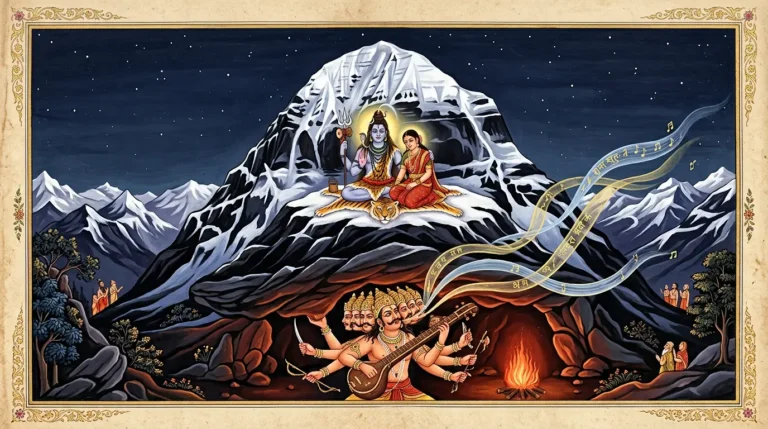
The Tandava Stotram deserves its one sentence here even though its page tells it fully: it is the sound of the dance itself, the drum in the words, composed, the tradition says, by the ten-headed king of Lanka while trapped under Kailash. If you have ever felt a shiver at its rhythm, you have already met its author’s predicament in the sound.
The light and the forgiveness
Karpur Gauram, the aarati mantra
कर्पूरगौरं करुणावतारं संसारसारं भुजगेन्द्रहारम् ।
सदा वसन्तं हृदयारविन्दे भवं भवानीसहितं नमामि ॥
karpūragauraṃ karuṇāvatāraṃ
saṃsārasāraṃ bhujagendrahāram ।
sadā vasantaṃ hṛdayāravinde
bhavaṃ bhavānīsahitaṃ namāmi ॥
The Lord white as camphor, the embodiment of compassion, the essence of the world, wearing the king of serpents as his garland, ever dwelling in the lotus of the heart, together with Bhavani: to him, I bow. This is the most-sung temple mantra of Shiva in North India, the one that plays as the flame circles at dusk. Its hour: the close of prayer, the end of the day, the moment of gratitude.
The Kshama Prarthana, the forgiveness prayer
कराचरणकृतं वाक्कायजं कर्मजं वा ।
श्रवणनयनजं वा मानसं वापराधम् ॥
विहितमविहितं वा सर्वमेतत्क्षमस्व ।
जय जय करुणाब्धे श्री महादेव शम्भो ॥
karācaraṇakṛtaṃ vākkāyajaṃ karmajaṃ vā
śravaṇanayanajaṃ vā mānasaṃ vāparādham ।
vihitamavihitaṃ vā sarvametat kṣamasva
jaya jaya karuṇābdhe śrī mahādeva śambho ॥
Whatever wrong I have done by hand, by foot, by word, by body, by hearing or sight, by thought, whether commanded or not commanded, forgive all of it. Victory, victory to the ocean of compassion, the great God Shambho.
Some pages on the internet file this as a meditation mantra, but the tradition places it where it belongs: at the close of prayer, as the ask for forgiveness. It is the natural last verse of any puja, and the honest prayer of the day you know you wronged someone. Its hour: the end of worship, and the end of a hard day.
Which mantra for which hour: the honest matchmaker
The tables you will find elsewhere read like prescriptions: this mantra for money, this one for enemies. The tradition’s own way of matching is gentler and truer: mantras serve the hours of the heart. Here is the honest match.
| The hour of your life | The mantra that serves it |
| Every day, the plain remembering | Om Namah Shivaya |
| Illness, danger, the fear of endings | The Mahamrityunjaya |
| Study, decisions, the need for clarity | The Shiva Gayatri |
| A hard thing that must be done | Om Namo Bhagavate Rudraya |
| The close of prayer, gratitude | Karpur Gauram |
| The day you wronged someone | The Kshama Prarthana |
| Energy, joy, the fierce love of the dance | The Tandava Stotram |
| The sleepless night | Om Namah Shivaya, silently, slowly |
| The beginner who wants one | Om Namah Shivaya, kept faithfully |
The row the promise-culture pages will not write: there is no mantra on this page that exists to make you rich or defeat your enemies, and any page that tells you otherwise is selling something the tradition never sold. What each mantra actually offers is written honestly in its card above.
For the question of success, since so many search it: the tradition’s own framing is that success begins with the clarity to see the right action and the steadiness to carry it through. The Gayatri serves the first, the Panchakshara the second. That is the honest answer beneath the search.
How to chant: the complete practice table
Everything the tradition teaches about the practice, gathered in one place.
| Element | What the tradition holds |
| Count | One mala, 108 repetitions, is the standard round. Devotees commit to 1, 3, 5 or 11 rounds daily. For special occasions, 1,008 is the traditional sankalp. |
| Time of day | Dawn, Brahma Muhurta, is the most held. Dusk, the sandhya, is second. Pradosha, the thirteenth lunar evening, twice a month, is Shiva’s own hour. Monday and Maha Shivaratri hold the week and the year. |
| Direction | North or east, by preference. The tradition holds it as courtesy, not command. Shiva is not checking your compass. |
| Seat | A clean asana, wool or cotton or kusha grass, kept for practice. Not the bare floor. |
| Voice | Three grades: vaikhari, spoken aloud, the foundation. Upanshu, whispered, the middle. Manasik, silent, held in the mind with meaning, the deepest. Begin spoken; the practice deepens on its own. |
| Mala | Rudraksha is traditional for Shiva. Hold the beads with the right hand, thumb drawing each bead over the middle finger. Never cross the meru, the larger bead, the summit. |
| Consistency | Same seat, same time, same mala. Forty days is the traditional mandala for settling a practice. Regularity outweighs length. |
| Eligibility | Everyone. Women, men, children, elders, seekers of every background. The caution is care, not identity. Handle what is sacred as something sacred. |
The number 108 itself is held warmly in the tradition. One explanation counts nine planets through twelve constellations, nine times twelve making 108 kinds of change in a life, one bead for each, and then back to the beginning. Others count the 108 Upanishads, or the 108 energetic points of the heart. The count is a tradition, not a rule; the regularity is what matters.
And the Shiva Purana grades repetition itself: spoken aloud is the foundation, whispered is deeper, silent repetition with meaning held is the deepest. Read this as a promise. Everyone starts speaking aloud, and the practice deepens on its own. The night of Maha Shivaratri, which in 2027 falls on Saturday, 6 March, is the one night the tradition asks you to keep the mantra company through all four watches, from dusk to dawn.
What chanting actually does, honestly
What the scriptures say
The Shiva Purana calls the Panchakshara the essence of the Vedas and promises that even a single devoted repetition carries weight. The Mahimna Stotram says the Lord’s name, however offered, reaches him, whatever the imperfection of the offerer. These are the tradition’s own claims, quoted as scripture’s voice.
What devotees say
In their own words across forums, kitchens and generations: the mind settles. Sleep returns. The day acquires a spine. Something feels carried. Devotees who have chanted for decades describe the mantra becoming a companion rather than a tool, and that shift is the real fruit the reports keep circling.
What no honest page promises
No mantra on this page is a vending machine for wealth, cures, jobs or the defeat of your enemies. Pages that promise this are borrowing the authority of scripture to sell outcomes it never offered. What the tradition actually puts in five syllables is a slower breath, a gathered mind, an aimed heart, and a relationship that deepens for as long as it is kept.
Frequently asked questions
Which is the most powerful Shiva mantra?
The tradition’s own crown goes to the Panchakshara, Om Namah Shivaya, called the essence of the Vedas. The Mahamrityunjaya is the most powerful for healing and the fear of death, the Gayatri for illumination. The honest answer is that power in this tradition means suitability: the right mantra for your hour is the most powerful one for you.
How many Shiva mantras are there?
The core is five: the Panchakshara, the Mahamrityunjaya, the Shiva Gayatri, the Rudra salutation and the beej seeds. Around them stand dozens of hymns and prayers, and the full Sri Rudram contains hundreds of salutations. A householder does not need them all; the tradition itself says one mantra, kept faithfully, is enough.
What is the Shiva mantra for success?
The honest tradition frames success as clear sight plus steadiness. For the first, the Shiva Gayatri. For the second, Om Namah Shivaya. Pages that assign a specific mantra to money or jobs are selling a precision the tradition never claimed.
How many times should I chant a Shiva mantra?
One mala, 108 repetitions, is the classic round. Ten unhurried minutes daily beats an occasional thousand. The Purana ranks silent mental repetition highest, so even a traffic jam counts.
Which Shiva mantra should I chant on Monday?
Om Namah Shivaya. Monday belongs to Shiva, whose moon he wears. Add the Mahamrityunjaya if health is on your heart, and during Shravan month every Monday is held doubly special.
Can we chant Shiva mantras at home?
Yes, fully. The tradition’s home is the home. A quiet corner, a clean seat, water for the Lord if you keep a linga or an image, and the mala in your hand. No temple is required; the temple is a bonus, not a permission slip.
What is the difference between a mantra and a stotram?
A mantra is a seed, one line repeated: Om Namah Shivaya. A stotram is a hymn of many verses, sung through: the Tandava Stotram. The mantra plants; the stotram praises.
What is the Rudra mantra?
Om Namo Bhagavate Rudraya, the salutation to Rudra, the fierce form of Shiva. Its great source is the Sri Rudram of the Yajurveda, from which the Panchakshara itself also grows.
What is the Shiva Gayatri mantra?
Om Tatpurushaya Vidmahe, Mahadevaya Dhimahi, Tanno Rudrah Prachodayat. A prayer for illumination in the Gayatri meter, the Shaiva counterpart of the most famous meter in Hinduism. Its full treatment has a page coming.
What is the Mahamrityunjaya mantra used for?
Healing, protection and the release from the fear of death. It comes from the Rigveda 7.59.12 and is the mantra the tradition reaches for in illness and danger. Its cucumber image asks not for the denial of death but for a life that ripens and releases gently.
What is the Shiva beej mantra?
A single-syllable seed sound regarded as a concentrated form of divine energy. The tradition holds beej mantras with special care, and some schools reserve them for initiation. Beginners do not need them; the Panchakshara carries the whole tradition openly.
Can women chant Shiva mantras?
Yes, completely and always. The Ardhanarishvara form shows the goddess as half of Shiva’s own body. Women have chanted, taught and transmitted these mantras in every generation.
Which direction should I face while chanting?
North or east, by the tradition’s preference. It is held as a courtesy rather than a command. The state of the heart outranks the compass.
What is the best time to chant Shiva mantras?
Any time, honestly. Held special: dawn, dusk, the Pradosha evening twice a lunar month, Mondays, and the night of Maha Shivaratri, which falls on Saturday, 6 March in 2027.
What is the Shiva mantra for healing?
The Mahamrityunjaya. It is the tradition’s healing mantra par excellence, chanted at bedsides and in hospitals, for oneself and for others. It asks not for miracle but for ripeness and release.
Can non-Hindus chant Shiva mantras?
Yes. The mantras crossed the world through yoga and belong to anyone who receives them with respect. The tradition’s caution is about care, not identity.
What does Om Namah Shivaya mean?
Salutations to Shiva, the auspicious one. Five syllables, one per element of creation. The complete word-by-word meaning, the stotra and the practice path are on its full page.
What is the Mahamrityunjaya mantra’s meaning?
We worship the three-eyed one, fragrant and nourishing. As the ripe cucumber is released from its vine, may we be released from death into immortality. The image is release, not tearing; ripeness, not denial.
May the right mantra find you at the right hour. Om Namah Shivaya.
 Gods & Goddesses
  Mantras & Stotras
  Mantras & Stotras