
What is the Shiva Gayatri mantra?
The Shiva Gayatri mantra is the Gayatri form of prayer to Shiva: Om Tatpurushaya Vidmahe Mahadevaya Dhimahi Tanno Rudrah Prachodayat. It asks Rudra to set light into the mind. Devotees chant it at dawn and dusk for clarity, for study and for direction at the crossroads of life.
The full text, in the three forms the tradition uses:
ॐ तत्पुरुषाय विद्महे महादेवाय धीमहि ।
तन्नो रुद्रः प्रचोदयात् ॥
oṃ tatpuruṣāya vidmahe mahādevāya dhīmahi
tanno rudraḥ prachodayāt
We set our minds on Tatpurusha, the supreme person. We hold Mahadeva, the great god, in meditation. May that Rudra guide our intellect onward.
The mantra is short enough to learn in an evening and deep enough to keep for a lifetime. It carries three names of Shiva in twenty four syllables, and every one of those syllables is doing work. This page gives you the text, the meaning word by word, the story of where the Gayatri form comes from, and a complete practice path with nothing invented and nothing promised.
Some prayer books list this same mantra under the name Rudra Gayatri, because the last line names Rudra. Same prayer, second name. We say both so you can find your way in any book.
The text, word by word
Read the table slowly. Sanskrit mantras are compressed, and each word opens like a fist opening.
| Word | IAST | What it means |
| ॐ | oṃ | The primordial syllable, the sound the tradition hears underneath all sounds |
| तत्पुरुषाय | tatpuruṣāya | To Tatpurusha, the supreme person. The dative case aims the prayer at him |
| विद्महे | vidmahe | May we know, may we attain the knowledge of |
| महादेवाय | mahādevāya | To Mahadeva, the great god, god beyond the gods |
| धीमहि | dhīmahi | May we hold in mind, may we meditate upon |
| तन्नः | tannaḥ | That one of ours, tat and naḥ fused by sandhi. The Lord, close enough to call ours |
| रुद्रः | rudraḥ | Rudra, the howler, the storm, the fierce face of the same Shiva |
| प्रचोदयात् | prachodayāt | May he set in motion, may he drive forward, may he inspire |
Two small things a teacher would point out, so we point them out too.
The verbs are plural. Vidmahe and dhimahi both mean we, not I. A Gayatri is prayed in company, the living and the seeking and the generations before you, even when you chant it alone in a kitchen at five in the morning.
And the mantra carries exactly three names of Shiva, one to a line: Tatpurusha, then Mahadeva, then Rudra. Notice the movement. It begins with the farthest name, the transcendent person almost beyond reach. It passes through Mahadeva, the great god of the temple and the festival. It ends with Rudra, the storm that is close enough to hear. The prayer walks toward the Lord, and arrives asking for light.
The twenty four syllables, counted
The Gayatri pattern is three lines of eight syllables. Count the first line with us, out loud, the way a teacher would make you count it:
tat, pu, ru, ṣā, ya, vid, ma, he. Eight.
ma, hā, de, vā, ya, dhī, ma, hi. Eight again.
tan, no, ru, draḥ, pra, cho, da, yāt. Eight, and twenty four in all.
This is not decoration. The meter is the identity of the mantra, and in the next section you will see why that identity is three thousand years older than this particular prayer.
What the twenty four carry
Teachers of the tradition have never let a number this clean go unexplained. Some hold that the twenty four syllables of a Gayatri answer the twenty four principles of which the world is built, the tattvas of the old cosmologies, from earth upward to the subtlest stratum of mind. Hold that mapping while you chant, they say, and one round of the mantra carries you through the whole creation.
We report it as the tradition’s own reflection, which is what it is, and we add the observation that delights us most about this particular Gayatri. The mantra counts out twenty four syllables and then, in its first word after Om, it names the one who stands beyond the count. Tatpurusha. The person past the principles. The syllables walk you through the world, and the first name you meet is the one who is not the world. Whatever else a prayer is doing, that is very fine engineering.
Why is it called a Gayatri?
Because it is built on one of the oldest and most honored forms in the whole tradition. To understand the Shiva Gayatri, you first have to meet its mother.
Gayatri is first of all a meter, a shape of sound: three lines, eight syllables to a line, twenty four in all. It is the meter of the most famous verse in the Rigveda, verse 3.62.10, seen by the rishi Vishvamitra. That verse is addressed to Savitr, the impelling warmth of the sun, and it asks the exact thing this page’s mantra asks: that the divine may inspire our minds.
That mother verse is called the Savitri, and tradition recites it prefixed by Om and by the three utterances, bhur bhuvah svah, earth, air and heaven. The Taittiriya Aranyaka, section 2.11, records this framing. The Savitri is imparted to a young student at the sacred thread ceremony, a moment sometimes called Gayatri diksha, initiation into the Gayatri. It is the most guarded mantra in the tradition, taught by a father or a teacher, whispered as a gift.
Now look at the frame of the mother verse: vidmahe, may we know. Dhimahi, may we meditate. Prachodayat, may he inspire. That frame is fixed. Keep the frame, set a different Lord’s name into the dative case, and you have a new Gayatri. The tradition did this for every great deity. There is a Gayatri of Ganesha, a Gayatri of Vishnu, a Gayatri of the Goddess. The Shiva Gayatri sets Tatpurusha, Mahadeva and Rudra into the ancient pattern, and the pattern carries the prayer.
The mother verse carries a human story too, and it is worth a minute of your time. Vishvamitra was a king before he was a seer. The tradition tells of a feud with the sage Vasishtha that cost him his army and his pride, and of a man who then spent years, by some tellings whole ages, wrenching himself into a rishi by nothing but will. The Rigveda credits him with an entire mandala of hymns, the third, and this verse stands at its summit. When you chant any Gayatri, you are holding the meter of a man who would not stop until the heavens answered him. That is the tradition’s own telling of its own meter, and it is good to know whose shape of sound you are borrowing.
Here is the honest history, and we give it to you straight because it matters. The Shiva Gayatri is not a verse of the Rigveda. It belongs to the family of deity Gayatris that the later tradition composed inside the Vedic frame, and you will find it in prayer collections and Agamic literature rather than in the Vedic samhitas. The pattern is ancient. The prayer in this form is later. Both facts are part of the tradition’s own genius, and no page should blur them to sound more venerable. When a website tells you this mantra comes straight from the Rigveda, it is selling you a lineage the mantra does not need. The meter is the lineage.
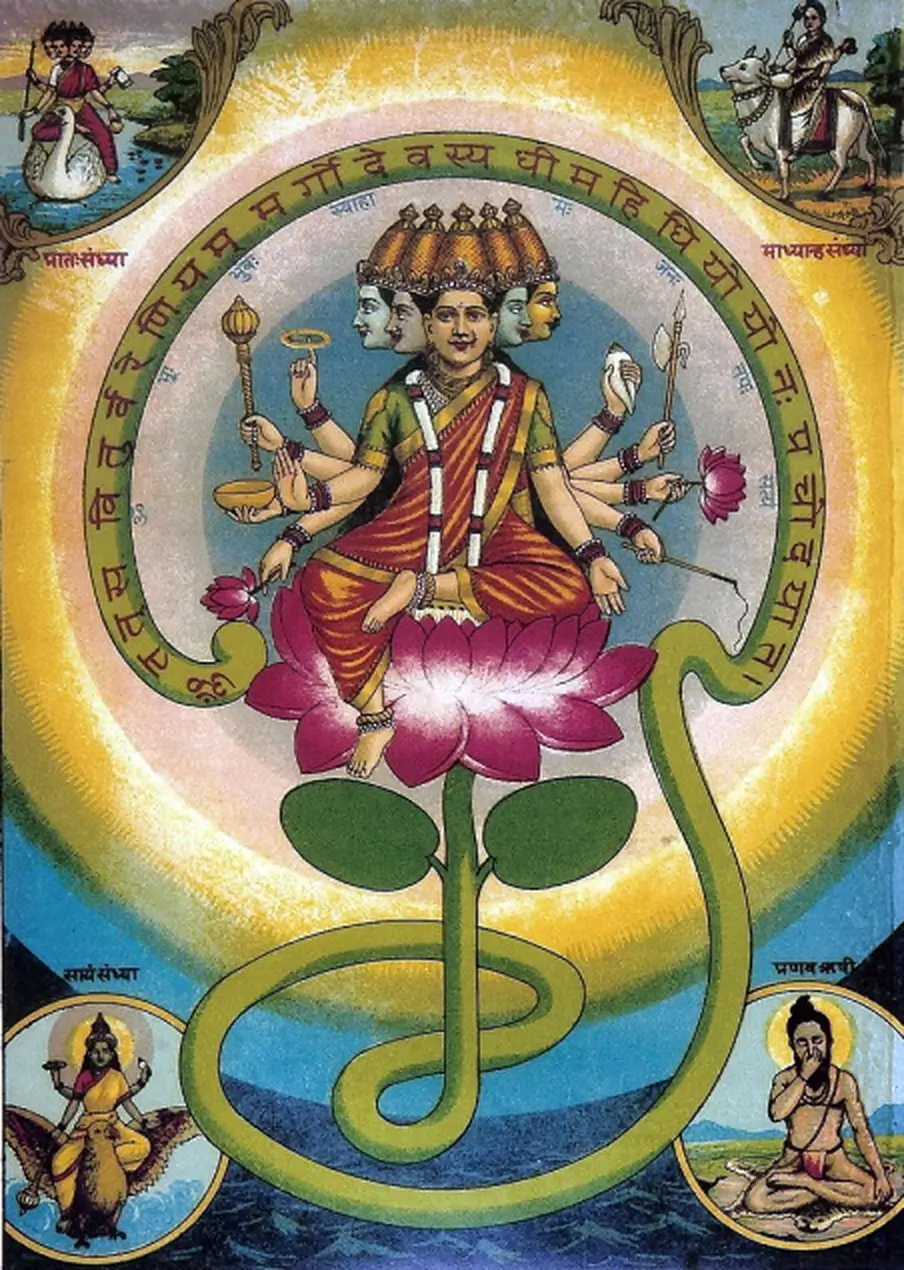
One more layer, because it is beautiful. The Puranas personify the Gayatri itself as a goddess: five faced, seated on a swan, called Vedamata, the mother of the Vedas. Tradition holds that she carries the essence of the four Vedas in her twenty four syllables. Her five faces have their own echo in Shiva, and that echo is where we go next. Her five look in five directions, and the devotee of Shiva will hear the echo at once. Her five, his five, the same pattern repeating at different altitudes of one tradition, the meter in the sky and the god on the mountain keeping the same count.
Why the junction hours
The Gayatri belongs to the sandhya, the junctions of the day, and the tradition’s reason for this is worth understanding rather than just obeying. Dawn is a door between night and day. Dusk is another. Noon, in the old reckoning, is the hinge where the morning leans into the afternoon. The tradition has always believed that thresholds are where the sacred is closest, the doorway, the riverbank, the first day of the month, the minute the lamp is lit. So the prayer of illumination is kept at the hours when the light itself is changing.
You do not have to accept any metaphysics to notice the practical truth underneath it. A dawn room is a different country from a noon room. The mind you meet at those hours is quieter, and a quiet mind is what the mantra is for. The tradition built the timetable around the psychology, centuries before anyone used that word.
Tatpurusha, the name that hides a face
The first name of the mantra deserves its own moment, because it is doing more than it seems.
Tatpurusha means that person, the transcendent one, the purusha beyond all the categories of this world. The word comes from tat, that, and purusha, person. It is the farthest reach of the names of Shiva, the one you cannot picture.
In the Shaiva tradition, Shiva is described with five faces, one for each direction the Lord looks from. Our page on the five syllables introduces them through the Panchakshara: Sadyojata, Vamadeva, Aghora, Tatpurusha and Ishana. The mapping belongs to the Agamas and the temple tradition, and lineages keep their own fine details. In the mapping most temples keep, Tatpurusha is the eastern face, the face of the rising light.
So the mantra begins at the eastern face, the impersonal person, and walks to Rudra, the voice in the storm. Far to near. Formless to fierce. And then, having arrived, it asks for the one thing Gayatri prayers always ask: light on the mind that is doing the asking.
If you meet a reader who wants the whole map of Shiva’s names, the eighty names, the thousand names, the five faces and the three eyes, send them to the complete guide to Shiva himself on this site. This page stays with its one name.
Shiva Gayatri, Om Namah Shivaya and the original Gayatri: which one when
Three great prayers, one Lord, three different hours of the heart. This is the question people actually ask, so here is the honest matchmaker.
| Prayer | What it asks | Its natural hour |
| Om Namah Shivaya | Remembrance. Salutation to Shiva, again and again | Every day, any hour, walking or sitting |
| The Shiva Gayatri | Illumination. Light on the mind, clarity for study and decisions | Dawn and dusk, the junction hours |
| The Savitri Gayatri | The original, addressed to Savitr, the sun’s impulsion | The sacred thread tradition, sandhya worship |
A plain way to hold it. The Panchakshara is the daily bread. The Gayatri is the study lamp. Neither replaces the other, and the tradition that built both never asked you to choose.
People also ask which one is more powerful. No honest teacher sells mantras by horsepower. The tradition’s own answer, repeated across its texts, is that the mantra kept faithfully outweighs the mantra collected in dozens. Devotion is the engine. The syllables are the vehicle it rides. Choose the one your day can actually hold, and let the rest wait for their hour.
For the full map of every mantra of Shiva, the shelf with its librarian, our hub page gathers them all.
How to chant: the complete practice path
Here is the path as the tradition gives it, in the order a beginner actually needs it. Nothing here requires a guru at your elbow, though the tradition always smiles on finding one.
Learn the sound first
Before you chant, listen. Find a recording by a tradition singer and let it play a dozen times, the way you learn a song before you sing it at a wedding. The Rajshri Soul recording, Shiv Gayatri Mantra 108 Times with Lyrics, carries the standard text at a learner’s pace, and it is linked in our sources. Learn the sound from a voice, not from a page, because Sanskrit on a page keeps its music hidden.
The sound, syllable by syllable
Sanskrit is kinder to learners than its reputation suggests. The vowels come in pairs, short and long, and the long ones are simply held twice as long. The capitals below mark the syllables you hold. Everything else is short and quick.
| Word | Say it like this |
| oṃ | one long AUM, three tones sliding into one, a as in car, u as in put, m closing the lips |
| tatpuruṣāya | tut-pu-ru-SHAA-ya |
| vidmahe | vid-MAA-hay |
| mahādevāya | ma-haa-day-VAA-ya |
| dhīmahi | DHII-MAA-hi, the first syllable like the ee in deep |
| tannaḥ | tun-noh, both syllables short |
| rudraḥ | ROO-druh, with a faint breath of an h at the end |
| prachodayāt | pra-cho-daa-YAAT, the last syllable held longest of all |
Two sounds ask for a little patience. The ṣ in puruṣāya is a sha made with the tongue a little further back than English sh. The ḥ at the end of rudraḥ is not a full syllable, only a soft echo of breath, like the last wisp of the word leaving the room. Get those two and no pandit in any temple will correct you, and none would anyway, because the tradition prizes a sincere accent over a polished one. The recordings teach both sounds in ten seconds of listening.
Sit, face and begin
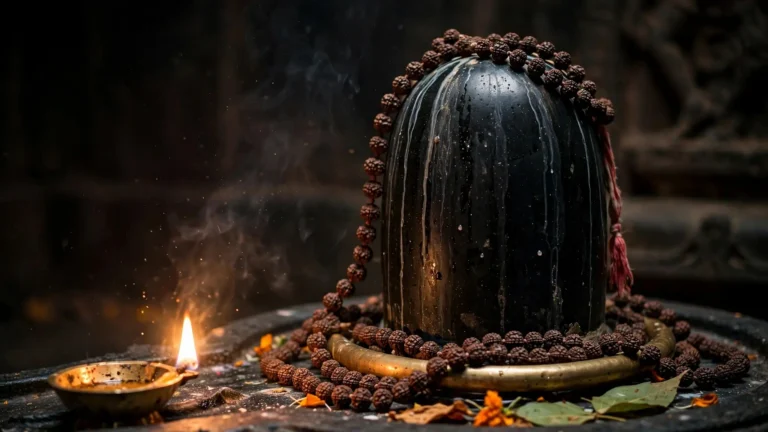
Sit facing east at dawn, or facing a Shiva image or lingam if you keep one. A folded blanket on the floor is enough. The tradition asks for a clean body and a clean seat, nothing more.
The count
Beginners chant nine or eleven repetitions, and that is a complete practice. The common householder count is one full round of a mala, 108. The devoted sometimes chant 1,008 on festival days and in Shravan, the monsoon month sacred to Shiva. The tradition does not demand a number. It asks for regularity, which is a harder teacher.
The pace and the pronunciation
Chant slowly enough that every syllable lands. The Gayatri meter has a natural walking rhythm, three steady strides to a line. Let the meaning ride the sound. When you lose the meaning, slow down and it comes back.
The hours that hold it
The junction hours are the mantra’s home: dawn, noon and dusk, the sandhya times when the tradition says day and night change guards. Monday is Shiva’s day and gives the practice extra weight. Maha Shivaratri, the great night of Shiva, is the summit of its year; in 2027 it falls on Saturday, 6 March. If you keep one special hour for this mantra, keep that one.
The days you cannot chant
There will be days when the schedule eats the practice. The tradition has already accounted for this. Mental repetition is held as the highest form, and listening is devotion too. On such a day, play the recording, sit quietly with folded hands, and let listening stand in for chanting. This is not our invention. It is the teaching of the nine modes of devotion, and it is older than every productivity system you have ever been sold.
Your first evening, honestly told
You will sit down, chant your eleven repetitions, and feel slightly ridiculous somewhere around the fourth. This is normal, and it passes. The syllables are new to your mouth, and your mouth is honest about new things. By the second evening, the mouth knows the road. By the second week, you will notice the sound arriving a half second before you speak it, the way a song you love starts playing itself in the stairwell. Nothing mystical has happened. You are learning a song, and the tradition has been patient with slower learners than you for a very long time.
Keep a small rule for the first month: same corner, same hour, eleven repetitions, no negotiating with yourself at the appointed time. The corner and the hour will start to do half the work for you. This is the entire secret that the expensive retreats will not tell you, offered here for the price of a page.
The mistakes beginners make
We have watched pilgrims take up practices for twenty years, and the stumbles are always the same four.
Speed. Chanted fast, the Gayatri turns into a tongue race and loses its stride. If you cannot feel the three lines walking, you are running.
Number worship. Eleven repetitions kept daily will carry you further than 1,008 performed once for an audience. The tradition’s arithmetic has always been regularity multiplied by time, and it has never once rewarded the weekend hero.
Comparison. Somewhere around week three, many people ask whether they should have picked a different mantra, a stronger one, a rarer one. This is the mind shopping, not the heart praying. Any mantra you actually keep becomes the strong one.
Quitting at the flat stretch. Every practice has a month where the novelty is gone and the fruit has not arrived. The tradition mapped this valley long ago and simply says to keep walking. The people who chant for decades are not the gifted ones. They are the ones who kept walking.
A week with the mantra
For those who like to see the shape of a thing before living in it, here is the practice as a week. Monday, the light is a little longer, maybe a full mala of 108. The other days hold eleven at dawn, or at dusk, or both when the day allows. Saturday you may rest or listen. Sunday evening, sit once more and notice what has changed in the room of your mind since Monday. In Shravan and in the week of Maha Shivaratri, the whole rhythm deepens by itself, because everyone around you is keeping it too, and the tradition carries you the way a river carries a swimmer.
The Shiva Gayatri in Tamil
The Tamil tradition chants this mantra in Tamil script, carrying the Sanskrit sounds in its own letters, a heritage that goes back through the grantha script of the temple scholars:
ஓம் தத்புருஷாய வித்மஹே மஹாதேவாய தீமஹி
தன்னோ ருத்ரஹ் பிரசோதயாத்
Pronunciation follows the Sanskrit. The letters are Tamil, the sound is the same prayer, and Tamil households have chanted it this way for generations.
A note on the other version you may hear
Some recordings and some books carry a sister version that begins Om Mahadevaya Vidmahe Rudramurtaye Dhimahi Tannah Shivah Prachodayat. The frame is identical, and the names are the same family, Mahadeva, Rudramurti, Shiva, only shuffled in order. Most printed prayer books give the Tatpurusha version this page teaches, and that is the one to keep as your anchor. If you learned the other from a grandmother or a recording you love, you learned a true prayer. The tradition is wide enough for both.
Who can chant the Shiva Gayatri mantra?
Women, yes. Beginners, yes. Seekers of any background, yes, with respect. Here is the honest detail behind each yes.
The initiation tradition belongs to the mother Gayatri. The Savitri is imparted at the sacred thread ceremony, and for most of history that ceremony was for boys of the three twice born classes. That is the strict lineage, and we do not blur it. For the Gayatris of the individual gods, the practice is different. These circulate openly in prayer books, and the living tradition chants them in kitchens, schools and ashrams, women and men together. Mothers teach the Shiva Gayatri to children before exams. Women scholars and saints of the Shaiva tradition, from the poets of the Tamil land to the teachers of today, have carried these prayers for centuries. If anyone tells you a woman may not chant this mantra, they are describing a gate the tradition itself stopped keeping for this prayer long ago.
Non Hindus may chant it under the same rule the tradition gives everyone: receive the sound with respect. The mantra does not check passports. It asks for care, the care you would give anything sacred that belongs to another’s house.
What the tradition asks instead of eligibility is simpler and harder: cleanliness, sincerity, and respect for the sound. Bring those three, and the door is open.
What the tradition says the Shiva Gayatri does
Every mantra page on the internet has a benefits section, and most of them are written by people selling something. Here is ours, held to the tradition’s own voice.
The mantra asks, in its plainest translation, for the Lord to drive the mind forward. Its subject is illumination. Students have taken it before study, and families before decisions, and the anxious at the ends of long days, for as long as the Gayatri frame has existed. The tradition connects it with clarity of intellect, steadiness of attention and the softening of confusion, and if you have ever sat with a slow repeated prayer for twenty minutes, the mechanism needs no miracle story: the breath lengthens, the attention gathers, the heart aims itself somewhere higher than its own noise.
In the houses of this country, where our company has its roots, the Gayatri is the sound of exam season. Mothers sit with children at dawn and the two of them chant before the books open, in Kathmandu apartments and Gorkha farmhouses alike, and have done for generations. Ask any of those mothers what the mantra does and you will not hear metaphysics. You will hear that the child sits better, that the morning starts clean, that something in the house is in order. That is the tradition working at street level, which is where traditions actually live.
The wider Gayatri tradition carries the tradition’s own claims, and we report them as tradition, not as promises. It calls Gayatri the mother of the Vedas. It says the mother verse is the essence of the three Vedas compressed, and that its repetition at the junction hours is the daily worship of the sun of the mind. These are the words of sages about a prayer they loved. They are not contracts, and this page will not turn them into ones.
What we will not tell you, because no text says it: that this mantra removes doshas from your horoscope, or guarantees exam results, or fulfills specific wishes on a schedule. Pages that promise those things are selling the tradition short, and the tradition has survived five thousand years without needing a marketing department.
What an honest practitioner can expect is smaller and better: a slower breath, a gathered mind, twenty four syllables that stay with you at crossroads, and the quiet dignity of keeping a practice. In our experience of twenty years of pilgrimage, that is already a great deal.
Frequently asked questions
What is the Shiva Gayatri Mantra?
The Shiva Gayatri Mantra is a prayer to Shiva in the ancient Gayatri pattern: Om Tatpurushaya Vidmahe Mahadevaya Dhimahi Tanno Rudrah Prachodayat. It asks Rudra to illuminate the intellect. It is chanted at dawn and dusk for clarity, study and guidance.
What is the meaning of the Shiva Gayatri Mantra?
We meditate on Tatpurusha, the supreme person. We hold Mahadeva, the great god, in our minds. May that Rudra guide our intellect onward. The verbs are plural, we, and the single request is light on the mind.
How many times should I chant the Shiva Gayatri Mantra?
Begin with nine or eleven repetitions. The common practice is one mala round of 108, and the devoted chant 1,008 on Mondays, in Shravan and on festival days. Regularity matters more than the number.
Who can chant the Shiva Gayatri Mantra?
Anyone who receives it with respect. The initiation tradition belongs to the mother Gayatri, the Savitri, imparted at the sacred thread ceremony. The Shiva Gayatri and its sibling Gayatris circulate openly and are chanted by women, men, beginners and seekers of every background.
Can women chant the Shiva Gayatri Mantra?
Yes. These Gayatris are held open to all, and women have chanted and taught these prayers throughout the living tradition. The sacred thread restriction applies to the Savitri Gayatri, not to this mantra.
What is the best time to chant the Shiva Gayatri Mantra?
The junction hours, dawn, noon and dusk, are the mantra’s home, with dawn the most practiced. Monday, the month of Shravan and the night of Maha Shivaratri add traditional weight.
What is the difference between the Gayatri Mantra and the Shiva Gayatri Mantra?
The original Gayatri Mantra is Rigveda 3.62.10, seen by Vishvamitra and addressed to Savitr. The Shiva Gayatri uses the same fixed frame, vidmahe, dhimahi, prachodayat, with the names Tatpurusha, Mahadeva and Rudra set into it. The frame is Vedic, and the Shiva prayer in this form belongs to the later deity Gayatri family.
Is the Shiva Gayatri Mantra in the Vedas?
Not as a verse. It is not found in the Rigveda or the other samhitas. It is a later composition in the Vedic Gayatri pattern, preserved in prayer collections and Agamic literature. Its meter and frame are ancient, and its honesty about its own history is worth more than a borrowed lineage.
What is the Rudra Gayatri Mantra?
Rudra Gayatri is a second name for the Shiva Gayatri, taken from its last line, which names Rudra. Some books also use the name for a sister version beginning Om Mahadevaya Vidmahe. Both carry the same Gayatri frame.
What are the benefits of the Shiva Gayatri Mantra?
The tradition connects it with illumination, clarity of intellect, steady attention and relief from confusion, and it is traditionally chanted by students and at times of decision. It is a prayer for light on the mind, not a mechanism for material outcomes. Any page promising specific results is going beyond what the texts say.
Which is more powerful, Om Namah Shivaya or Shiva Gayatri?
The tradition’s answer is that the mantra kept faithfully is the powerful one. Om Namah Shivaya is the daily remembrance, any hour, any place. The Shiva Gayatri is the lamp for study and the junction hours. Devotion is the engine, not the choice of syllables.
Can I chant the Shiva Gayatri Mantra at night?
Yes. The junction hours are its tradition, and dawn and dusk are its natural home, but the mantra carries no curfew. Students chant it in the evening, and night vigils of Shiva worship, especially around Maha Shivaratri, are part of the tradition’s own calendar.
What is the Shiva Gayatri Mantra in Tamil?
ஓம் தத்புருஷாய வித்மஹே மஹாதேவாய தீமஹி தன்னோ ருத்ரஹ் பிரசோதயாத். The Tamil script carries the Sanskrit sounds through the grantha heritage of the Tamil temple tradition, and the pronunciation follows the Sanskrit.
The mantra and the mountain
We end where our house always ends, at the mountain.
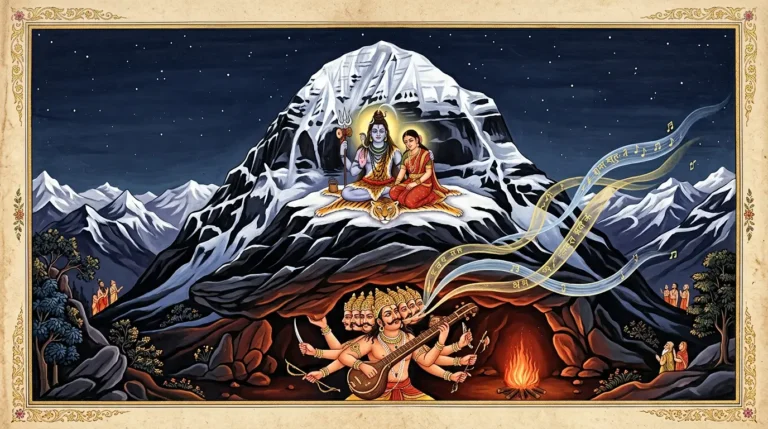
Mount Kailash is held to be Shiva’s own seat, the home of the Lord whose Gayatri you have just learned. Every year since 2006 we have walked pilgrims around it, and we can tell you what the Gayatri looks like at 5,630 metres, on the pass called Dolma La, in wind that takes your breath and gives it back as prayer.
It looks like this: an old woman from Gujarat telling her beads one syllable at a time with frozen fingers, a monk from Lhasa sounding his own tradition’s om beside her, and a guide from Kathmandu who knows the line between them was never as wide as maps pretend. Twenty four syllables travel well. They weigh nothing at altitude, which is more than can be said for almost everything else a person carries.
You do not need the mountain to chant this mantra. The kitchen at dawn is a complete temple. But if the kitchen practice ever grows roots and starts asking for the mountain, you should know that the junction hours are kept up there too, and the dawn over Kailash is the finest classroom for this prayer that the earth currently offers. When that call comes, our door in Kathmandu is open, and has been for twenty years.
May the light you are asking for arrive before you stop asking. If it is the mountain itself that calls you, the journeys we arrange to his mountain walk every year, and our door in Kathmandu is open.
 Mantras & Stotras
 Mantras & Stotras
 Mantras & Stotras