
Last updated October 2026. Written by Basudev Panday, from a house that has served the pilgrims of Shiva’s mountain for twenty years.
What are the 108 names of Lord Shiva?
The 108 names of Lord Shiva are the Shiva Ashtottara Shatanamavali, a garland of one hundred and eight names recited in daily worship and during the ritual bathing of the lingam. Each name salutes one quality, form or deed of Shiva, from the auspicious one at the start to the supreme Lord at the close. Devotees chant the list on Mondays, on festival nights and, above all, during abhishek, where one stream of offering is poured for every name. You will hear it in every Shiva temple you ever enter, and once you know it, you will hear it everywhere.
This page gives you the complete list in Devanagari, in roman transliteration and in English, with every name verified against two independent editions of the received text, so you can trust what you are reciting. It also gives you the things no other page on this subject carries: where the list actually comes from, chapter and verse, why the count is exactly 108, how the list differs from the thousand names, and how to recite it properly, learned from a house that runs the trails and temples where the names are chanted.
A note before the list, because honesty is this house’s rule, and you deserve it before you spend an hour with this text. The received text carries two names twice, Girishaya at positions sixty and sixty one, and Hara at ninety six and one hundred. That is not a copying error on our part. It is the received text itself, and the section on origins explains what the tradition does with it.
What Ashtottara Shatanamavali means
The name of the hymn is a map of the hymn. Ashtottara shata means one hundred and eight, literally eight beyond a hundred. Namavali means a garland of names. So the title hands you the whole picture: a garland of one hundred and eight names, strung for wearing, which in your case means reciting.
Every line of the garland uses the same frame, and the frame is worth understanding before you begin, because once you see it, you can chant any namavali in the tradition. Each name sits between two fixed words. Om opens the line, the primordial syllable that stands before everything in the tradition. Namaha closes it, the bow, the salutation. Between them, the name itself appears in the dative case, the grammar of movement toward: shivaya does not just mean Shiva, it means to Shiva, aimed at him. So the line Om Shivaya Namaha carries its whole teaching in its grammar: the primal sound, moving toward the auspicious one, ending in a bow.
This is the same frame our page on the five syllables teaches for the Panchakshara, and it is the frame of every namavali you will ever meet. What changes is only the name in the middle. One hundred and eight times, the chant walks the same road toward one hundred and eight different doors of the same house.
The full list, with meanings
The complete received list, in the order the editions print it. The Devanagari is the received text. The transliteration follows the international standard, so you can pronounce it from any keyboard. The meaning is ours, written fresh for this page, one line for each name. Read the list aloud, even your first time, and the garland teaches itself.
Part one, the first twenty seven
| No | In Devanagari | Transliteration | Meaning |
| 1 | ॐ शिवाय नमः | oṃ śivāya namaḥ | the auspicious one |
| 2 | ॐ महेश्वराय नमः | oṃ maheśvarāya namaḥ | the great lord |
| 3 | ॐ शम्भवे नमः | oṃ śambhave namaḥ | the source of happiness |
| 4 | ॐ पिनाकिने नमः | oṃ pinākine namaḥ | holder of the bow Pinaka |
| 5 | ॐ शशिशेखराय नमः | oṃ śaśiśekharāya namaḥ | crowned with the crescent moon |
| 6 | ॐ वामदेवाय नमः | oṃ vāmadevāya namaḥ | the beautiful, pleasing form |
| 7 | ॐ विरूपाक्षाय नमः | oṃ virūpākṣāya namaḥ | whose eyes have no equal |
| 8 | ॐ कपर्दिने नमः | oṃ kapardine namaḥ | the matted crown of hair |
| 9 | ॐ नीललोहिताय नमः | oṃ nīlalohitāya namaḥ | the blue and the red, dawn coloured |
| 10 | ॐ शङ्कराय नमः | oṃ śaṅkarāya namaḥ | the giver of joy |
| 11 | ॐ शूलपाणये नमः | oṃ śūlapāṇaye namaḥ | the trident in his hand |
| 12 | ॐ खट्वाङ्गिने नमः | oṃ khaṭvāṅgine namaḥ | bearer of the skull tipped staff |
| 13 | ॐ विष्णुवल्लभाय नमः | oṃ viṣṇuvallabhāya namaḥ | dear to Vishnu |
| 14 | ॐ शिपिविष्टाय नमः | oṃ śipiviṣṭāya namaḥ | the light that enters all things |
| 15 | ॐ अम्बिकानाथाय नमः | oṃ ambikānāthāya namaḥ | lord of Ambika, of the Mother |
| 16 | ॐ श्रीकण्ठाय नमः | oṃ śrīkaṇṭhāya namaḥ | of the lovely throat |
| 17 | ॐ भक्तवत्सलाय नमः | oṃ bhaktavatsalāya namaḥ | tender to his devotees |
| 18 | ॐ भवाय नमः | oṃ bhavāya namaḥ | existence itself |
| 19 | ॐ शार्वाय नमः | oṃ śārvāya namaḥ | the ending one, Sharva |
| 20 | ॐ त्रिलोकेशाय नमः | oṃ trilokeśāya namaḥ | lord of the three worlds |
| 21 | ॐ शीतिकण्ठाय नमः | oṃ śītikaṇṭhāya namaḥ | the blue throated one |
| 22 | ॐ शिवप्रियाय नमः | oṃ śivapriyāya namaḥ | the beloved of Parvati |
| 23 | ॐ उग्राय नमः | oṃ ugrāya namaḥ | the fierce, the overwhelming |
| 24 | ॐ कपालिने नमः | oṃ kapāline namaḥ | whose bowl is a skull |
| 25 | ॐ कामारये नमः | oṃ kāmāraye namaḥ | the slayer of desire |
| 26 | ॐ अन्धकासुरसूदनाय नमः | oṃ andhakāsurasūdanāya namaḥ | the destroyer of the demon Andhaka |
| 27 | ॐ गङ्गाधराय नमः | oṃ gaṅgādharāya namaḥ | the Ganga held in his hair |
Part two, names twenty eight to fifty four
| No | In Devanagari | Transliteration | Meaning |
| 28 | ॐ ललाटाक्षाय नमः | oṃ lalāṭākṣāya namaḥ | the eye in the forehead |
| 29 | ॐ कालकालाय नमः | oṃ kālakālāya namaḥ | the death of death |
| 30 | ॐ कृपानिधये नमः | oṃ kṛpānidhaye namaḥ | the treasury of compassion |
| 31 | ॐ भीमाय नमः | oṃ bhīmāya namaḥ | the tremendous |
| 32 | ॐ परशुहस्ताय नमः | oṃ paraśuhastāya namaḥ | the axe in his hand |
| 33 | ॐ मृगपाणये नमः | oṃ mṛgapāṇaye namaḥ | the deer held in his palm |
| 34 | ॐ जटाधराय नमः | oṃ jaṭādharāya namaḥ | the matted hair worn |
| 35 | ॐ कैलासवासिने नमः | oṃ kailāsavāsine namaḥ | who lives on Kailash |
| 36 | ॐ कवचिने नमः | oṃ kavachine namaḥ | the armoured one |
| 37 | ॐ कठोराय नमः | oṃ kaṭhorāya namaḥ | the stern, the unyielding |
| 38 | ॐ त्रिपुरान्तकाय नमः | oṃ tripurāntakāya namaḥ | the end of the three cities |
| 39 | ॐ वृषाङ्काय नमः | oṃ vṛṣāṅkāya namaḥ | whose emblem is the bull |
| 40 | ॐ वृषभारूढाय नमः | oṃ vṛṣabharūḍhāya namaḥ | seated on the bull |
| 41 | ॐ भस्मोद्धूलितविग्रहाय नमः | oṃ bhasmoddhūlitavigrahāya namaḥ | the body smeared with sacred ash |
| 42 | ॐ सामप्रियाय नमः | oṃ sāmapriyāya namaḥ | lover of the Sama Veda’s song |
| 43 | ॐ स्वरमयाय नमः | oṃ svaramayāya namaḥ | made of sound itself |
| 44 | ॐ त्रयीमूर्तये नमः | oṃ trayīmūrtaye namaḥ | the three Vedas in one form |
| 45 | ॐ अनीश्वराय नमः | oṃ anīśvarāya namaḥ | who has no lord above him |
| 46 | ॐ सर्वज्ञाय नमः | oṃ sarvajñāya namaḥ | the all knowing |
| 47 | ॐ परमात्मने नमः | oṃ paramātmane namaḥ | the supreme self |
| 48 | ॐ सोमसूर्याग्निलोचनाय नमः | oṃ somasūryāgnilocanāya namaḥ | whose eyes are moon, sun and fire |
| 49 | ॐ हविषे नमः | oṃ haviṣe namaḥ | the receiver of the offering |
| 50 | ॐ यज्ञमयाय नमः | oṃ yajñamayāya namaḥ | sacrifice itself in living form |
| 51 | ॐ सोमाय नमः | oṃ somāya namaḥ | the moon, the cool nectar one |
| 52 | ॐ पञ्चवक्त्राय नमः | oṃ pañcavaktrāya namaḥ | the five faced one |
| 53 | ॐ सदाशिवाय नमः | oṃ sadāśivāya namaḥ | the eternally auspicious |
| 54 | ॐ विश्वेश्वराय नमः | oṃ viśveśvarāya namaḥ | the lord of the universe |
Part three, names fifty five to eighty one
| No | In Devanagari | Transliteration | Meaning |
| 55 | ॐ वीरभद्राय नमः | oṃ vīrabhadrāya namaḥ | the hero born of his rage |
| 56 | ॐ गणनाथाय नमः | oṃ gaṇanāthāya namaḥ | lord of the ganas, the hosts |
| 57 | ॐ प्रजापतये नमः | oṃ prajāpataye namaḥ | the lord of creatures |
| 58 | ॐ हिरण्यरेतसे नमः | oṃ hiraṇyaretase namaḥ | the golden seed, the creative source |
| 59 | ॐ दुर्धर्षाय नमः | oṃ durdharṣāya namaḥ | the one none can withstand |
| 60 | ॐ गिरीशाय नमः | oṃ girīśāya namaḥ | monarch of the holy mountain, of Kailash |
| 61 | ॐ गिरीशाय नमः | oṃ girīśāya namaḥ | lord of the Himalaya, the received double |
| 62 | ॐ अनघाय नमः | oṃ anaghāya namaḥ | the faultless |
| 63 | ॐ भुजङ्गभूषणाय नमः | oṃ bhujaṅgabhūṣaṇāya namaḥ | the serpent worn as ornament |
| 64 | ॐ भार्गाय नमः | oṃ bhārgāya namaḥ | the radiant, of the Bhrigu line |
| 65 | ॐ गिरिधन्वने नमः | oṃ giridhanvane namaḥ | whose bow is the mountain |
| 66 | ॐ गिरिप्रियाय नमः | oṃ giripriyāya namaḥ | the lover of mountains |
| 67 | ॐ कृत्तिवाससे नमः | oṃ kṛttivāsase namaḥ | clad in the hide |
| 68 | ॐ पुरारतये नमः | oṃ purārataye namaḥ | the enemy of the demon cities |
| 69 | ॐ भगवते नमः | oṃ bhagavate namaḥ | the Lord, the adorable |
| 70 | ॐ प्रमथाधिपाय नमः | oṃ pramathādhipāya namaḥ | lord of the dancing host |
| 71 | ॐ मृत्युञ्जयाय नमः | oṃ mṛtyuñjayāya namaḥ | the victor over death |
| 72 | ॐ सूक्ष्मतनवे नमः | oṃ sūkṣmatanave namaḥ | the subtle bodied |
| 73 | ॐ जगद्व्यापिने नमः | oṃ jagadvyāpine namaḥ | the pervader of the world |
| 74 | ॐ जगद्गुरवे नमः | oṃ jagadgurave namaḥ | the teacher of the world |
| 75 | ॐ व्योमकेशाय नमः | oṃ vyomakeśāya namaḥ | whose hair is the sky |
| 76 | ॐ महासेनजनकाय नमः | oṃ mahāsenajanakāya namaḥ | the father of Kartikeya |
| 77 | ॐ चारुविक्रमाय नमः | oṃ cāruvikramāya namaḥ | the beautiful striding one |
| 78 | ॐ रुद्राय नमः | oṃ rudrāya namaḥ | the howler, the storm |
| 79 | ॐ भूतपतये नमः | oṃ bhūtapataye namaḥ | lord of the beings |
| 80 | ॐ स्थाणवे नमः | oṃ sthāṇave namaḥ | the pillar, the motionless one |
| 81 | ॐ अहिर्बुध्न्याय नमः | oṃ ahirbudhnyāya namaḥ | the serpent of the depths |
Part four, names eighty two to one hundred eight
| No | In Devanagari | Transliteration | Meaning |
| 82 | ॐ दिगम्बराय नमः | oṃ digambarāya namaḥ | the sky clad |
| 83 | ॐ अष्टमूर्तये नमः | oṃ aṣṭamūrtaye namaḥ | the eight formed one |
| 84 | ॐ अनेकात्मने नमः | oṃ anekātmane namaḥ | the one soul in the many |
| 85 | ॐ सात्विकाय नमः | oṃ sātvikāya namaḥ | the pure, the serene |
| 86 | ॐ शुद्धविग्रहाय नमः | oṃ śuddhavigrahāya namaḥ | the spotless in form |
| 87 | ॐ शाश्वताय नमः | oṃ śāśvatāya namaḥ | the eternal |
| 88 | ॐ खण्डपरशवे नमः | oṃ khaṇḍaparaśave namaḥ | the axe that cuts through |
| 89 | ॐ अजाय नमः | oṃ ajāya namaḥ | the unborn |
| 90 | ॐ पाशविमोचकाय नमः | oṃ pāśavimocakāya namaḥ | the releaser from all bonds |
| 91 | ॐ मृडाय नमः | oṃ mṛḍāya namaḥ | the gracious one |
| 92 | ॐ पशुपतये नमः | oṃ paśupataye namaḥ | the lord of all creatures |
| 93 | ॐ देवाय नमः | oṃ devāya namaḥ | the shining god |
| 94 | ॐ महादेवाय नमः | oṃ mahādevāya namaḥ | the great god, Mahadev |
| 95 | ॐ अव्ययाय नमः | oṃ avyayāya namaḥ | the unchanging |
| 96 | ॐ हरये नमः | oṃ haraye namaḥ | the taker of sorrow |
| 97 | ॐ पूषदन्तभिदे नमः | oṃ pūṣadantabhide namaḥ | who broke Pushan’s teeth |
| 98 | ॐ अव्यग्राय नमः | oṃ avyagrāya namaḥ | the untroubled |
| 99 | ॐ दक्षाध्वरहराय नमः | oṃ dakṣādhvaraharāya namaḥ | the ender of Daksha’s sacrifice |
| 100 | ॐ हराय नमः | oṃ harāya namaḥ | the remover, Hara received again |
| 101 | ॐ भगनेत्रभिदे नमः | oṃ bhaganetrabhide namaḥ | who pierced Bhaga’s eyes |
| 102 | ॐ अव्यक्ताय नमः | oṃ avyaktāya namaḥ | the unmanifest |
| 103 | ॐ सहस्राक्षाय नमः | oṃ sahasrākṣāya namaḥ | the thousand eyed |
| 104 | ॐ सहस्रपदे नमः | oṃ sahasrapade namaḥ | the thousand footed, standing everywhere |
| 105 | ॐ अपवर्गप्रदाय नमः | oṃ apavargapradāya namaḥ | the giver of liberation |
| 106 | ॐ अनन्ताय नमः | oṃ anantāya namaḥ | the endless |
| 107 | ॐ तारकाय नमः | oṃ tārakāya namaḥ | the ferry across, the liberator |
| 108 | ॐ परमेश्वराय नमः | oṃ parameśvarāya namaḥ | the supreme Lord |
The closing line and the text’s own promise
The received text ends with a colophon and a fruit verse, and both belong on any complete page. The colophon reads: Iti Sri Shiva Ashtottara Shata Namavali, thus ends the garland of one hundred and eight names of Shiva. The fruit verse, the phalashruti, makes the text’s own promise: whoever chants these one hundred and eight auspicious names of Lord Shiva will be blessed by the Lord, and this stotra is capable of removing all sins.
We quote that promise as the text’s own claim, which is what it is. The tradition records it as the reward of the recitation. What a page can honestly add is smaller and surer: the steady mind that an hour of named attention builds, which every practitioner of every tradition recognises.
Where the names come from
The received text stands in the Shiva Rahasya, part 7, chapter 13, verses 203 to 215, and its speaker is Vishnu, who teaches the names to Parvati. The old commentary of Nilakantha Dikshita notes that the hymn is said to come from the Skanda Purana, an attribution the modern editors of the received text mark as unverified, and we pass that footnote on to you exactly as the scholars leave it. Popular summaries credit the Shiva Purana and the Linga Purana, which carry the ocean of names the tradition draws from, and the confusion is understandable, because all these mountains belong to one range.
What the list actually is, in the tradition’s own life, is a liturgical selection: the daily garland, drawn from the ocean of names, shaped for your recitation, carried by the temple priests of the subcontinent into every abhishek ritual. No single rishi signs it. It belongs to the tradition the way a path belongs to a mountain, walked into shape by uncountable feet.
One honest note on the received text itself, which you met at the top of this page. The editions print Girishaya twice, at sixty and sixty one, and Hara twice, at ninety six and one hundred. The commentators read the double Girishaya as two aspects of one mountain lordship, Kailash’s monarch and the Himalaya’s lord, and the double Hara as sorrow taken and then taken again entirely. Some web lists quietly delete one of each to make the count tidy. We print the received text as the tradition keeps it, doubles and all, and count honestly to one hundred and eight, which is what the editions themselves do.
The smaller variant readings, where editions genuinely differ, kept plainly in the open:
| Position | The reading this page prints | Also read as |
| 19 | Sharvaya, the ending one | Sarvaya |
| 20 | Trilokeshaya | Trilokishaya |
| 25 | Kamaraye, the slayer of desire | Kaumaraye |
| 43 | Svaramayaya, made of sound | Sarvamayaya |
| 60 and 61 | Girishaya twice, the received double | some lists drop one |
| 90 | Pashavimochakaya | Pashavimochanaya |
| 96 | Haraye | Prabhave |
A text that varies between editions is not a defect. It is the signature of a living liturgy, recited across a subcontinent for centuries, and any page that hides the variants from you is doing both you and the tradition a small discourtesy.
Why 108: the number the tradition keeps
No single text decrees that the count shall be one hundred and eight. The number arrived from several directions over the centuries, and the tradition, characteristically, kept them all. The classical anchors you can check yourself, and you should: the Muktika Upanishad’s canon counts 108 Upanishads. The Vedic sky has 27 lunar mansions, each with four quarters, and 27 by 4 is 108. The same sky has 12 houses and 9 planets, and that product is 108 too. The mala you would hold to count the names has 108 beads, and it has had them for as long as anyone can measure. Hold one while you read this section and the arithmetic becomes devotion.
The traditions add their own layers, held as tradition: the yoga schools teach that 108 energy channels converge toward the heart centre, so a round of 108 touches them all, and Ayurveda counts its 107 vital points and then counts the whole self as the 108th. No one of these is the reason. All of them together are the reason, and the one that matters most on this page is the simplest: the garland of names and the mala of beads hold the same count, one name per bead, the list and the rosary made for each other.
108, 1000 and 1008: the three lists, untangled
Searchers mix these three numbers constantly, and the mixing is forgivable, because the tradition itself uses all three. If you have mixed them yourself, here is the untangling.
| List | What it is | Where it stands |
| 108 names, the Ashtottara | The daily garland, this page | The Shiva Rahasya, spoken by Vishnu to Parvati |
| 1000 names, the Sahasranama | The full ocean, for the great recitations | The Mahabharata, Anushasana Parva, Book 13, Chapter 17 |
| 1008 names | The thousand plus the frame, the auspicious count | Printed editions of the Purana recensions |
The thousand names carry their own story, and it is a good one, worth your ten minutes. In the Anushasana Parva of the Mahabharata, Krishna teaches the thousand names to Yudhishthira, and tells him where he learned them, from the sage Upamanyu, who had the hymn from the ascetic Tandi.
The hymn runs to about a thousand names in 119 verses, with a meditation verse at the head and a fruit verse at the close. Other recensions exist across the scriptures: the Kotirudra Samhita of the Shiva Purana carries one in the voice of Vishnu, the Vayu Purana another, the Shanti Parva preserves Daksha’s version, and the Devi Bhagavata keeps Bhagiratha’s.
The tradition also speaks of 1,008, the auspicious count the printed editions reach by their arrangement of the frame verses. If you meet a page that treats these three lists as one thing, you may safely discount the page, and you now know why. They are one ocean, but three crossings.
The names that carry the whole story
Every name is a door, and some of them open onto rooms you have already walked through on this site. Twelve of the one hundred and eight, read a little deeper, for the pleasure of it:
Pinakine, number 4. Pinaka is Shiva’s bow, and the name salutes the archer before the ash and the silence.
Kapaline, number 24. The skull bowl recalls the Brahma’s head story and the ascetic’s vow, the fierce object carried by the gentlest of the gods.
Andhakasura Sudanaya, number 26. The blind demon Andhaka, born of Shiva’s own shadow in the telling, ends absorbed into the Lord who unmade him, destruction turned into inclusion.
Tripurantakaya, number 38, and Giridhanvane, number 65. The three cities of the ego fell to one arrow, and the bow that fired it, in the Purana’s telling, was Mount Meru itself strung for a bow. The two names tell one story across twenty seven positions.
Kalakalaya, number 29, and Mrityunjayaya, number 71. Time’s own end, and the victor over death. Between them they hold the reason the healing mantra of the tradition, the Mahamrityunjaya, is Shiva’s.
Virabhadraya, number 55, with Pushadantabhide at 97 and Bhaganetrabhide at 101. The hero born of rage at Daksha’s sacrifice, whose rampage broke Pushan’s teeth and pierced Bhaga’s eyes. Three names, one catastrophe, the story the complete guide to Shiva himself tells in full.
Mahasenajanakaya, number 76. Mahasena is Kartikeya, and the name hides the family inside the list: the father of the war god, saluted in the same breath as the hermit of Kailash.
Ahirbudhnyaya, number 81. The serpent of the depths, which the commentators read as the coiled energy waiting at the base of the spine, the tantric layer of the list surfacing for one line.
Ashtamurtaye, number 83. The eight forms: earth, water, fire, air, sky, sun, moon and the sacrificer. The whole world as his body, stated in a single dative.
Pashupataye, number 92. The lord of creatures, the name Nepal gave its greatest temple, and the one this house hears most often on the trail.
The names are not decoration on the stories. They are the stories, compressed to a syllable and strung in order. Learn even a dozen of them well, and the tradition says the garland becomes the theology.
How to recite the 108 names
The recitation is learned by ear before it is read by eye, so listen before you begin. Your ear is a better Sanskrit teacher than your eye, and it is more patient. The Mahakatha recording chants the received text at a learner’s pace, and it sits at the top of this section for exactly that purpose.
The mala method
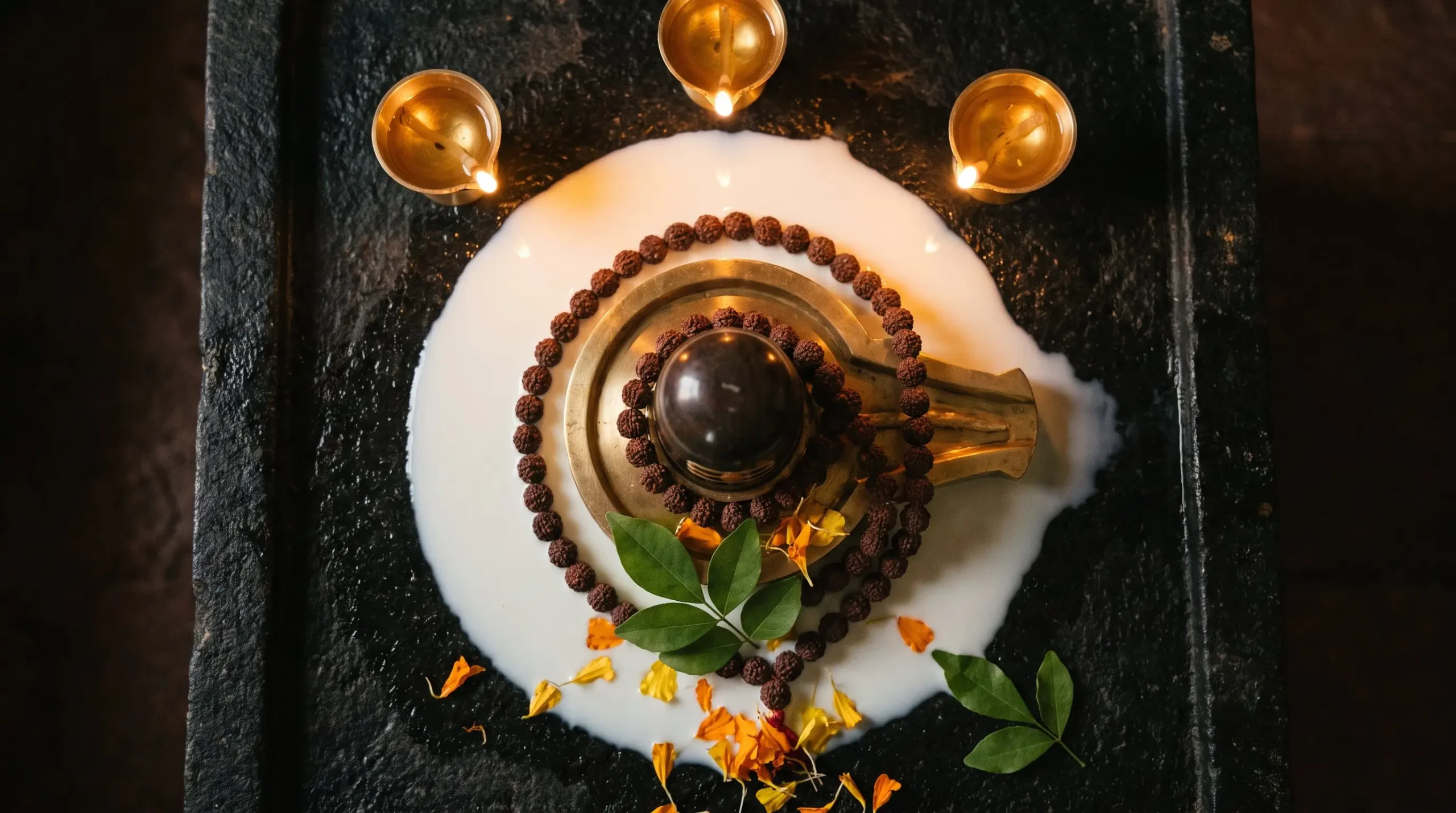
Hold a 108 bead mala in the right hand, resting on the middle finger. Chant Om Namah Shivaya eleven times to settle yourself, then begin the garland, one name per bead, Om and Namaha around each. One full round is the complete practice. If you have no mala, count on your fingers; the tradition approves of whatever count the hand can keep.
The Monday method
Monday is the names’ own day. Face east or north, sit for the length of the mala round, and keep the count you can keep. Nine rounds for the devoted, one for the busy, the same garland either way. Pradosha evenings, the thirteenth moon, and the whole month of Shravan add traditional weight to any Monday’s practice.
The abhishek method
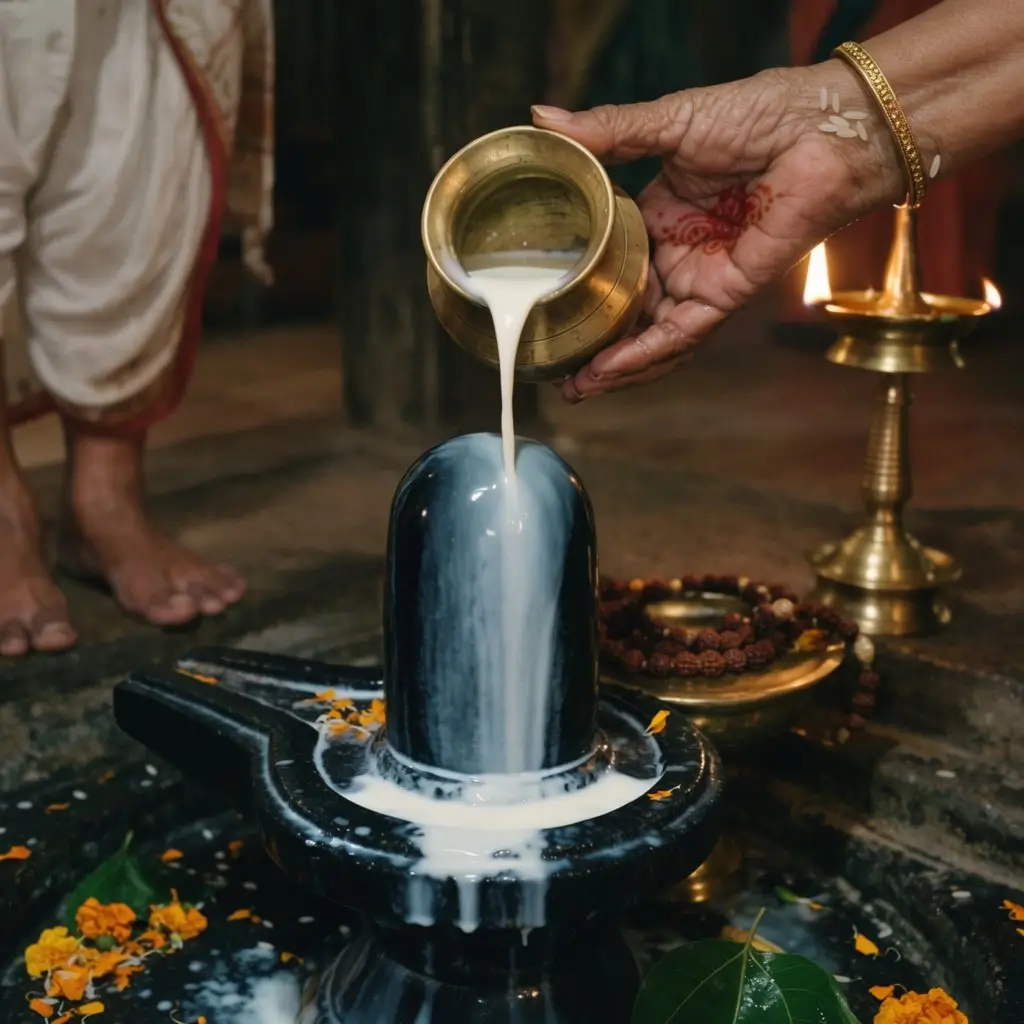
This is the names’ fullest life. During the ritual bathing of the lingam, the reciter chants the garland and pours one stream of water or milk for every name, one hundred and eight offerings in all. If you have ever watched a temple Rudrabhishek, the unhurried rhythm you remember was this, the list and the ritual moving at the same pace. At home, a small lingam or even a simple stone, a cup of water and the list you have just read are a complete abhishek. The Shiva Gayatri on its own page pairs naturally with this practice for the hour before.
Your first recitation, honestly told
You will lose your place somewhere around name thirty, and the mala will save you. You will mispronounce Khatvangine for a month, and the tradition, which ranks your devotion above your polish, will not mind. By the third Monday the sequence begins to carry itself. That is the entire arc, and everyone who keeps the practice has lived it, including everyone in our house. The one rule that matters is the one the tradition itself gives: regularity over intensity, the garland kept weekly rather than heroic once.
What the tradition says chanting does
The fruit verse, quoted in full above, is the tradition’s own claim, and we let it speak in its own voice rather than translating it into a promise it never made. The softer claims, made by every generation of practitioners, are the ones this house can stand behind from experience: an hour of named attention steadies the breath and settles the mind.
Students chant the garland before study, the anxious before sleep, families before journeys. Your reason for beginning it is yours, and the list does not ask. This page will not tell you that the recitation cures illness or guarantees outcomes, because no text says that, and pages that do are selling something the tradition never stocked. You deserve better than a bought promise. What the tradition offers is the practice, the count, and the company of everyone who has kept it. On the evidence of several thousand years, that has been enough.
Frequently asked questions
What are the 108 names of Lord Shiva?
The 108 names of Lord Shiva are the Shiva Ashtottara Shatanamavali, a garland of one hundred and eight names beginning Om Shivaya Namaha and ending Om Parameshvaraya Namaha, recited in daily worship and during abhishek. The full list with Devanagari, transliteration and meanings is on this page.
What is Shiva Ashtottara Shatanamavali?
Shiva Ashtottara Shatanamavali is the formal name of the 108 names. Ashtottara shata means one hundred and eight, and namavali means a garland of names, so the title describes exactly what the hymn is.
What does Ashtottara mean?
Ashtottara means eight beyond a hundred, one hundred and eight. The word appears in the title of every deity’s 108 name hymn in the tradition, Shiva’s, Vishnu’s, Ganesha’s and the rest.
Where do the 108 names of Shiva come from?
The received text stands in the Shiva Rahasya, part 7, chapter 13, verses 203 to 215, spoken by Vishnu to Parvati. A commentary of Nilakantha Dikshita notes a Skanda Purana attribution that editors mark as unverified, and the Shiva and Linga Puranas carry the wider ocean of names the garland draws from.
Who wrote the 108 names of Lord Shiva?
No single author signs the namavali. It is a liturgical text of the Shaiva tradition, preserved by temple recitation, with its received placement in the Shiva Rahasya. The thousand name hymn, by contrast, carries a named chain: Tandi to Upamanyu to Krishna to Yudhishthira.
How many names does Lord Shiva have in total?
The tradition speaks of a thousand names, the Sahasranama, and counts 1,008 in the auspicious arrangement, with the 108 name garland as the daily selection. By any count, the names are understood as countless in principle, one for every aspect of the Lord.
What is the difference between 108 names and 1000 names of Shiva?
The 108 names are the daily garland for worship and abhishek. The 1000 names, the Sahasranama, are the full hymn from the Mahabharata’s Anushasana Parva, taught by Krishna to Yudhishthira, used for the great recitations. The 108 is the working day’s crossing of the same ocean.
Why are there 108 names in Hinduism?
The count 108 is sacred across the tradition: the mala has 108 beads, the Vedic sky’s 27 mansions times 4 quarters gives 108, the Muktika canon lists 108 Upanishads, and the yoga and Ayurveda traditions carry their own 108 counts. The names follow the number the tradition keeps everywhere.
Why is 108 a sacred number?
No single text decreed it. The count appears independently in the astronomy, the Upanishad canon, the mala, the yogic channels and the vital points, and the tradition kept all of these meanings together. A sacred number with one explanation would be an ordinary number.
How do I chant the 108 names of Lord Shiva?
Learn the sound from a recording first. Then hold a 108 bead mala, chant Om Namah Shivaya eleven times, and recite one name per bead with Om before and Namaha after. Monday is the natural day, and one round is a complete practice you can keep for life.
What are the benefits of chanting Shiva’s 108 names?
The fruit verse promises the Lord’s blessing and the removal of sins, and we quote it as the text’s own claim. In lived experience, the steady practice brings a settled mind and a steadier breath, which is why students, families and travellers have kept it for centuries.
Can I recite the 108 names daily?
Yes, and daily is the tradition’s own preference. One mala round on your ordinary day, the full abhishek on Mondays and festivals. On days you cannot, listening to a recording counts as keeping your practice.
Which day is best for reciting Shiva’s names?
Monday, the still god’s own day. Pradosha evenings, the Shravan month’s Mondays, and the night of Maha Shivaratri, Saturday 6 March in 2027, carry the greatest traditional weight.
What is the meaning of the first name, Om Shivaya Namaha?
Om is the primordial syllable, Shivaya means to Shiva, the auspicious one, in the grammar of approach, and Namaha is the bow. The first name holds the frame every other name you chant will use.
Can we chant 108 names during abhishek?
Yes, and the abhishek is the names’ fullest use: one stream of water or milk poured for each name, 108 offerings over the lingam. The temple Rudrabhishek you may have watched runs on exactly this count.
Related guides
- The Mantras of Shiva: the complete list with meanings
- Om Namah Shivaya: the complete guide to the Panchakshara
- The Shiva Tandava Stotram: lyrics, meaning and Ravana’s story
- The Shiva Gayatri Mantra: meaning, full text and how to chant
- Who Is Lord Shiva: the complete guide
The garland ends where every garland should, at the name of the supreme Lord, and then it begins again, because that is what garlands do. Yours is waiting on the page above, all one hundred and eight of it. If your practice ever grows roots and starts asking for the mountain where these names live, the journeys we arrange to his mountain walk every year, and the door in Kathmandu is open. For the full shelf of every mantra and hymn this house has documented, with the recordings and practice paths to match what you have just learned, the complete shelf of Shiva mantras keeps them all.
Sources
The received text of the Shiva Ashtottara Shata Namavali, its Shiva Rahasya placement and the Nilakantha Dikshita commentary note follow the sanskritdocuments repository, verified against a second independent edition, name by name, with the count confirmed at exactly 108, in October 2026. The Sahasranama facts follow the Mahabharata, Anushasana Parva, Book 13, Chapter 17, and the recension list in Wikipedia’s Shiva Sahasranama entry. The Muktika Upanishad’s canon provides the 108 Upanishad count. The recitation practice follows the tradition as this house keeps it, and the recording recommended for learning the sound is the Mahakatha chant linked above. The meanings of the names are written fresh for this page, and where editions differ, the variant table states it plainly.